d: Where do books fit?

The Unprecedented Audacity of the iBooks Author EULA:

In other words: Apple is trying to establish a rule that whatever I create with this application, if I sell it, I have to give them a cut. And iBooks Author is free, so this arrangement sounds pretty reasonable.

[This is being bandied back and forth. Where else but through iBooks would an iBooks file be used so who cares, or maybe it was an overzealous lawyer at Apple, or as the above. What is the place of books in the future of education.

I was rarely interested in sitting and reading a textbook. Even history, with its arc and story was often reduced to a memorization of a bunch of facts about which I no longer had the slightest interest. But science lab, or a field trip to a historical place, or anything where you did something, worked with something, *touched* something worked for me.

So where do textbooks fit? Where does it make sense to have a primary learning experience consist of this? Most of us can look up facts whenever we need them. We can find well written accounts of virtually any topic, and it’ll include almost up to the minute news and recent changes in all but the most esoteric fields.

What I’d like to see for my kid is some sort of 1:1 iPad to student program. That should easily cover the 5 Rs. Art class, music class, etc. can all be bought this way as well, although I wouldn’t try and remove the chance for kids to play real instruments, apply paint to canvas, water color, go to museums, and mix stuff together in a science lab. Quite the opposite, I would encourage that more time and money be spent on those things. The social experience of going to school, the chance to bring Noah first hand (literally) experience with things that I cannot are why I want from his school. I admit, to my sorrow, that part of this is also “day care”. Both my wife and I work, so we need to make sure some one we trust is caring for Noah, but I want that time filled with great stuff now, while his mind is like a sponge. For the moment, Noah’s working on the basics (reading , writing, etc.) Soon those things will be just gateway skills to the real stuff. And I want him to have a modern education, not one that was designed 100 years ago.]

Source: venomous porridge
New York City gets a Software Engineering High School

New York City gets a Software Engineering High School:

This fall New York City will open The Academy for Software Engineering, the city’s first public high school that will actually train kids to develop software. The project has been a long time dream of Mike Zamansky, the highly-regarded CS teacher at New York’s elite Stuyvesant public high school. It was jump started when Fred Wilson, a VC at Union Square Ventures, promised to get the tech community to help with knowledge, advice, and money.

[Cool!]

Source: Joel on Software

Beth on Brushes (more education related ranting)

beth_art_ipad

Beth on Brushes:

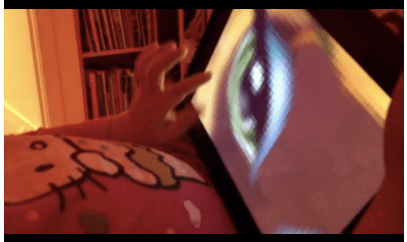
I made this video of Beth lying in bed using Brushes on her iPad to trace a cartoon character. I was struck by the level of sophistication in her interaction with the app and made this quick video. All the voiceover was added in post, except for the part where I help her with the brush sizing.

Beth is four years old. Four.

[This is what art class ought to look like in 2011. I wish my son’s did. Go check out the video on Frasier’s page.]
Source: Fraser Speirs

Some of you have this all wrong. This isn’t whether I can afford to buy Noah an iPad. My complaint is that educators aren’t changing the way they teach fundamental skills for a world that already operates differently. Never mind how it will operate 20 years from now when my kid is finishing up his basic education.

Steve Jobs in 1980 (and how schools still get this wrong)

Why do school kids have one computing experience at home and in their personal lives, and a completely out of touch, ancient experience at school? I’ll get back to that.

Steve Jobs in 1980:

Same vision. Same goals. What he was talking about then applies almost completely to what Apple is doing today. (Via Michael B. Johnson.)

[Gruber pointed to this video from 1980 and if you’re a student of Steve Jobs you’ll have heard these themes before. The condor & the bicycle for example was very common in his talks from those years. Two things struck me as I watched this.

Something struck me at about 10:18 in the video. Steve is talking about how different the experience is when there is one computer to an individual not, what was until then, common—many people sharing one computer. Despite our collective understanding of this, made clear by the shear number of computers available to schools so many of us, most schools have one computer shared by many students for short periods of time as a curricular addition. Gym, art, music, computers. Asides in the daily lives of students everywhere. This is clearly ridiculous in age of iTouches, smartphones, iPads, texting, tweeting etc. How could we possibly not have computers in the hands of students all day every day.

Some schools courtesy of some smart administrators are getting this right. Integrating computing into the curriculum at its base, not as a course of study. That’s key. The teachers must use them for their coursework. Homework, communication, the entire experience of school must be integrated. Don’t teach “computers” in the classroom, use computers in the classroom.

The second thing, an aside really, is that recordings will *not* be scarce in the future. Almost everything that someone does publicly will most likely have a recording made and available for the future. This can be good, and bad. The bad that I’m thinking about is that it might be harder for people to evolve if their past is so well documented. The good is obvious, that we’ll be able to study people in far greater depth, in the direct way that seeing an image of them provides.]
Source: Daring Fireball

Paypal: feel the love

Paypal: feel the love:

You’ve probably read about (or even felt) the anger over Paypal “stealing money” from Regretsy, which is only the latest in a series of things they’ve done that have pissed the Internet off. I suspect, given the attention this is getting, they’ll fix this. (Unlike them cutting off Wikileaks, this time Paypal is as coming as close to stealing from orphans before Christmas as one can get without writing a Dickens story.) This will quiet down. Then, within six months, they’ll do something else to piss the Internet off.

In no particular order, here’s a few random thoughts.

The key to understanding Paypal is this: Their policies in dealing with their customers are all crafted with the assumption that their customers are out to screw them. It’s not that they don’t want to do business with you, it’s that they don’t trust you. Ever. Under any circumstance. They want your money, but they hate you.

They hate you because in a measurable percentage of their transactions, people are trying to screw them over. As the cliché goes, it’s not paranoia when they really are out to get you.

Except that approaching every transaction with that attitude really is paranoia.

[The Internet is young, and we are collectively stupid for supporting organizations like this. Make sure you read the original post which is linked to in the first paragraph. It’ll make your blood boil, especially if you follow these stories (and toss in the issues folks have had with Google as well). What a mess.]
Source: Coyote Tracks

Writing

Writing: Communication skills are so important in life. The investment I’ve made in my communication skills over the past eight years is paying huge dividends for me now. I want to help my kids make the same investment, just much earlier in life. I know it will come in handy and I know it will be a great source of pleasure for them thoughout their life.

[We’re trying to help Noah get this as well.]
Source: A VC

Why the Keurig K-Cup is the beginning of the end for great coffee « Muddy Dog Roasting Co.

Why the Keurig K-Cup is the beginning of the end for great coffee « Muddy Dog Roasting Co.: Do you think that vision is crazy?  Let’s see.  How easy is it to buy a Walla Walla onion?  Never heard of it?  I’m not surprised.  I grew up with them, but they’re already a thing of the past.  Hundreds of vegetable varieties have already gone extinct, solely due to our desire to homogenize, to have crops that ship well, regardless of how they taste.  Only 5% of US apple varieties that existed just 200 years ago still exist today.   Ninety percent of vegetable varieties have gone extinct over the last 100 years in the UK. The crimson flowered broad bean, the Champion of England Pea, the Bath Cos Lettuce, and the Rowsham Park Hero Onion are just a few examples of vegetables that are lost forever.  Hundreds of heirloom vegetable varieties are on the brink of extinction.  And there are all kinds of other foods that are falling victim to this same phenomenon. Try to buy a really great charcuterie today – Boar’s Head is as close as you’ll get in most places.  A beautiful creme fraiche?   How about Yoplait?  Great cheeses?  We got your Kraft, RIGHT HERE.  Don’t believe me? Go check out Slow Food’s Ark of Taste.  Oh, what’s that, you would like to have a nice meal at a cute bistro?  Sorry, all that’s available now are chain stores like Panera, TGI Friday’s or Appleby’s.  But you can probably score some Jack Daniels chicken wings, or some other ill-advised mess.  I can sum it all up in one word: Monsanto.

[And while Jim of Muddy Dog Roasting Company explains from his perspective. I think this particular paragraph worries me more (I’m not a coffee drinker) in that it is part of a larger problem, which expressed perfectly above. And in case it isn’t obvious the lost biodiversity is not just a loss of taste and experience. That’s bad enough. But it has become entirely clear that eating different foods is healthy for you, and having variations of each food makes that easier (you eat a tomato, but it’s a different tomato). The varying balances of the “ingredients” of a fruit or vegetable is a fundamental goodness. And the craft of growing and preparing food, where the results are not consistent at the “Monsanto” level and don’t try to be is also a fundamental goodness. It’s the same thing that is appealing about anything hand made. Sure, a dreadnaught style guitar has certain fundamental qualities. But each one is different. Hand build a bicycle and each one will have some personality even if you use the same measurements and tube set. That variation is good for us. And we need to be extremely careful that we don’t lose it in a chase to the bottom in the name of efficiency and money.]
Source: Marco Arment

A Pattern Language

"When I was a child, I thought
God was disappointed
whenever some distraction interrupted...
Now I know that God expects such interruptions,
for He knows our frailty.
It is completion that surprises Him."

--From the God Whispers of Han Qing-jao

Noah loves playing with patterns. Colors, shapes, letters, lego pieces, alternation, similarity… the whole gamut.

But he also gets upset when for one reason or another he can’t complete a pattern the way he’d like. Lack of resources, lack of concentration. What have you. He likes a nice tidy world from that perspective (although not from many others…)

There’s much yet to teach.

A Supercomputer in Every Backpack

A Supercomputer in Every Backpack: People visit my school all the time. They shake my hand as they leave and tell me how inspiring it all is and often they sign off with “truly, the iPad is the future of education”. I bite my tongue every time because unlike Richard Stallman I’m not an anti-social jackass, but I want to correct them.

I want to tell them that the iPad is not the future of education, it’s the present of education. If we consign the iPad to the realms of the future, then we are implicitly saying that it’s not for right here, right now, today. We’re saying that we can postpone the task of seriously engaging with the educational and social impact of ubiquity of Internet-connected computing.

I ask you to consider other industries that put off dealing with such challenges. How is that approach working out for record companies? For newspapers? For booksellers?

The hour is already late. We have allowed a 16-year gap to develop between society and schools in terms of our children’s access to computers. Can we properly prepare Beth and her cohort for the year 2029 with the same level of access to computers that I had 35 years before?

How long can we let this gap continue to grow? Another five years? Another ten? In another 14 years, if GSMA are right, society as a whole will have 7 connected devices each – will we be delivering relevant education in that world if each pupil only has a third of a computer to themselves?

Cedars is not a school of the future. I think we’re a decade late. [Everything that Fraser has been working cuts close to my heart as I concern myself Noah’s education. What parts are his school getting right? What parts are they getting wrong? Where is it so bad that I need to shore it up, where can ignore it as it as irrelevant? Clearly his school has the computer and technology stuff wrong. But I don’t think it matters because that is something that I can (fortunately) fix. Not everyone can, but I (we) can. The stuff I can’t fix? What they feed him. The crappy behaviors he learns from the kids on the bus. Yeah, I know all survivable stuff, but considering the importance of these years… anyway, consider how your child’s education doesn’t match the needs of the marketplace. What are you going to do about it? Where do you think it’s lacking?]
Source: Fraser Speirs