
personal
d: Fun birthday preparations
This time of year it behooves me to make plans that allow me to enjoy my birthday. To that end I’ve lined up two things so far.
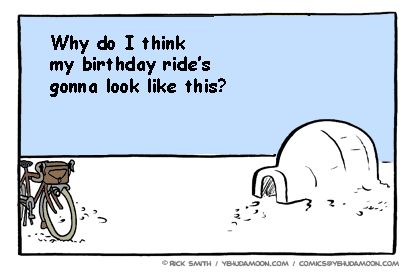
The first is a long standing tradition, which I try and share with my wonderfully crazy friends. A lot of folk have birthday traditions, and bike people often go on a long ride. Since my birthday is in winter, and often, the start of some of the worst winter weather this concept has it challenges. But I manage every year to at least get on a bike, outside, and uphold the tradition. We have a theoretical goal of riding one mile for each year of my age, however it often works out closer to kilometers. Other, um, enhancements to the ride have varied with temperature and terrain. Anyway, in theory the ride is on or around the 15th depending on weather and availability. Let me know if you care to join…

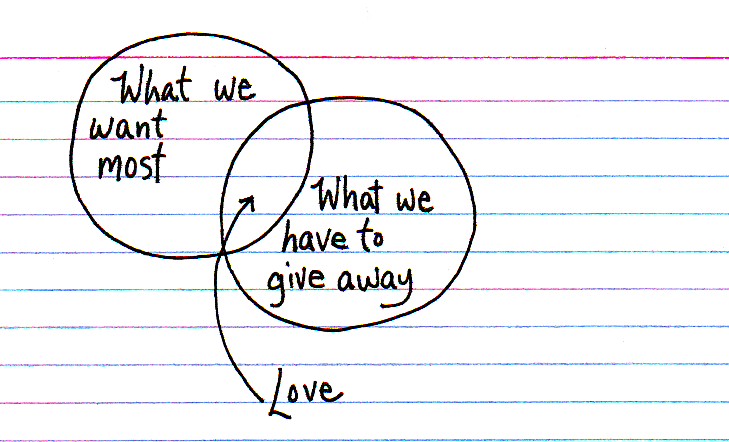
The second way I’ve prepared this year is with the following form (I wish I knew where I got it from. If anyone knows please let me know.) In jest, of course… but I have included a printed version of this with gifts I give, although there is a disclaimer about response time in the small print which you can’t see in this image. 
d: a few things I’ve noticed again
Most days the weather really doesn’t mean that much to me anymore. Whenever I’m going out to ride, hike, and maybe soon run, the assessment of the kit I would wear, which direction I would be going in, and how long I would be out are paramount. But as I spend more time indoors (usually working for a living) the weather makes not one iota of difference to my life. I have realized that without going out on my bike, my exposure to the elements is sadly limited.
It was cold in the morning back when I took the train into the City. At the station each morning it was about a ten to fifteen minutes wait. The station was packed at 7am every morning, but no one got there on foot or by bike. Many people are dropped off like little kids going to school, everyone else drove their car. Many of those folks would sit in there car with the engine running burning expensive gas, creating pollution, and going nowhere but staying warm until the last second. They then would bolt out of the cars completely under-dressed for the conditions knowing that they cacooned in moments, and then for the rest of the day. Sad. Get outside every day.
Other things I’ve noticed:
- I’m usually the problem. Simply by being flexible about an outcome I toss away stress, worry and concern. Sometimes the outcome is worth the effort or even the argument, but that’s rare. Which leads to…
- Having expectations is problematic. Because it leads to fighting for the outcome I “expected”. When I examine the outcome though it probably does not diminish my happiness at all, until I started trying to change it.
- It’s ok to mess up once in a while. This is somewhat obvious, but I rarely leave myself any room for this. Wrong.
- It’s ok to feel pain, mentally or physically. It will pass.
- Go big or go home.
- Everything always happens for a reason.
- Everything works out the way it’s supposed to.
- Being of service to others makes me happy.
“My disappointment came from expectations, from proposing a shape for the experience I was seeking and then feeling let down when the experience arrived in a shape other than the one I’d proposed.” Bill Barich’s “Laughing in the Hills.”
It wasn’t meant to Be
I was reminded by John Gruber that today was the day Apple acquired Next and with it the return of Steve Jobs started.
Back then I had kinda assumed that Apple was going to die and had already invested some amount of money buying a Be developer machine and started learning all that there was to this really neat OS. It had a lot of forward looking ideas built into it. Apple meanwhile was also failing to deliver any of its varied nextgen OS things (remember Pink?). The rumors swirled that Be, being built by former Apple executive Jean-Louis Gassée (who for a while there had Steve’s old position), was going to be purchased by Apple giving BeOS a home, and Apple a way forward. But at least from the outside, at the last second, Apple changed direction (all of this could have been rumors, I no longer remember) and bought Next instead. I was very disappointed. I thought the energy of the Be development community and Apple’s user base would jump start things. Of course, there’s no way to know if that’s true or not. I was not pleased.
Since then there’s been a lot of changes to Apple—now one of the largest companies in the world. Be is long gone. Little attention is afforded to operating systems by users. They’ve become a layer of services upon which we rely. Occasionally some bit of UI delights us. We have more devices hanging around but most folks don’t know what OS their phone runs, nor should they. It’s not relevant. The choices people make are based on what they wish to do with their phones, tablets, and laptops. If there’s something that they believe is crucial that runs on Windows, that’s what they’ll have, whether it’s true or not.
In fact, that’s kinda what all of this is about. It’s about what we believe, and what’s important to us. And someone believed that Steve could still do some good. What was appealing when I started using computers and then programming them was that Apple had menus when no one else did. Menu’s “remembered” things for me. Since I never had a good memory for trivia (and that’s what my brain considered all that command line stuff) I was more comfortable with Apple’s computers than the others. I could get menus to remember things for me. Also, being a musician full time back then, Apple had the best music software and the hearts and minds of the artistic community. I believed that they were better.
Some things aren’t meant to be. And in this case, who knows what the shape of the world would’ve been if Steve had continued to ply his trade elsewhere. Would he have given up on changing the world via technology? Would he have grown antsy with Pixar and meddled in the story creation process to the point of disaster? Would he have found a way, with a whole new company to create devices that so many love?
A self referential note
Funny how that works.
Some Thoughts On The Louis CK “Experiment”
Some Thoughts On The Louis CK “Experiment”:
But this can also work for emerging artists. They won’t make as much money as Louis CK, but they also don’t need to make as large of an investment either. And over time, if their work is good, their audience will grow and the investments they can make and the profits they can make will increase.
[This piece was going OK until he got to the paragraph above. I know he said “emerging” artist, which implies some following already in place. But the truth is that kick starting something like this is really, really, low odds. Like Lotto low. And I’m not saying that everyone has to do a six camera shoot of their gigs. I bet you could get a great shoot done with six IPhones for goodness sake. But that’s not my point. There is definite chicken and egg problem here, where not enough people know who you are and what you are doing to make virtually any production pay for itself, let alone make you money (never mind “real” money). The lesson I’d take away from what he did was how much of the work he did himself. Something that the super powerful computers sitting on many of our desks make possible. Look at what people are accomplishing by mastering their craft, and then how relatively little technology it takes to get an amazing recording on the ‘Nets for all to enjoy. And think about it. He could have walked away with nothing (or less than nothing) for his efforts too.]
Source: A VC
Steve Jobs in 1980 (and how schools still get this wrong)
Why do school kids have one computing experience at home and in their personal lives, and a completely out of touch, ancient experience at school? I’ll get back to that.
Steve Jobs in 1980:
Same vision. Same goals. What he was talking about then applies almost completely to what Apple is doing today. (Via Michael B. Johnson.)
[Gruber pointed to this video from 1980 and if you’re a student of Steve Jobs you’ll have heard these themes before. The condor & the bicycle for example was very common in his talks from those years. Two things struck me as I watched this.
Something struck me at about 10:18 in the video. Steve is talking about how different the experience is when there is one computer to an individual not, what was until then, common—many people sharing one computer. Despite our collective understanding of this, made clear by the shear number of computers available to schools so many of us, most schools have one computer shared by many students for short periods of time as a curricular addition. Gym, art, music, computers. Asides in the daily lives of students everywhere. This is clearly ridiculous in age of iTouches, smartphones, iPads, texting, tweeting etc. How could we possibly not have computers in the hands of students all day every day.
Some schools courtesy of some smart administrators are getting this right. Integrating computing into the curriculum at its base, not as a course of study. That’s key. The teachers must use them for their coursework. Homework, communication, the entire experience of school must be integrated. Don’t teach “computers” in the classroom, use computers in the classroom.
The second thing, an aside really, is that recordings will *not* be scarce in the future. Almost everything that someone does publicly will most likely have a recording made and available for the future. This can be good, and bad. The bad that I’m thinking about is that it might be harder for people to evolve if their past is so well documented. The good is obvious, that we’ll be able to study people in far greater depth, in the direct way that seeing an image of them provides.]
Source: Daring Fireball
Writers discover focus. Film at 11.
iPad 2 as a serious writing machine (how-to):
This is liberating for a writer, and I find I can write more, and better, on the tablet system than on a “real” computer. There are no menu options competing for my attention, no updates needing to be run, just an app on the screen. Those of us who write for a living know how precious it is when you get “in the zone” while writing. The zone is that mental place where the words just flow as fast as you can type them. I find I get in the zone far more often on the iPad than on other computers. I attribute that to my focus being forced to the task at hand, and that is priceless.
[So everyone that writes this mentions the above “focus” thing and the battery life (it’s very long compared to even a current laptop). But here’s the thing. Running any app full screen will provide the focus of which they are all so enamored. Some writing apps (for the Mac) were built with exactly this in mind, and completely hide the screen. It’s now fairly common on the Mac as many apps support Lion’s “full screen mode” which takes the menus off the top, the dock off the bottom or side, and eliminates tool bars etc. So again, other than cool factor, and battery life (what did all we do until now? The horror!) these articles are simply “look at me, I’m cutting edge.” articles. I agree that adding a keyboard transforms the feel of an iPad (or iPhone) entirely. And the battery life is gloriously freeing if you’re used to the dance of power cords, and timing, and outlets. But the focus thing strikes me as people who had no clue about what as available to them for years. The change, if you can consider it one, is that the iPad doesn’t provide a choice about “one thing at time”. It is that design decision that they’re actually praising. They’re embracing the constraint and saying “behold the beauty”, even if there are plenty of times it feels in the way. For example, working on a web design where switching back and forth between editor and browser is a back and forth whip saw like action that repeats many times.) But I’m so glad that all these writers who apparently are so undisciplined that they cannot ignore the flashing of their tweets, or the siren call of menu choices have found nirvana. Now if they would just write about something worthwhile, instead of informing us of their modern version of a #2 pencil.]
PS Don’t misunderstand. I love the combination of keyboard and iPad or iPhone, it’s a really great way to go for writers and some types of tasks. But it doesn’t replace a big screen for everything. It’s just a tool, albeit a great one for some tasks.
In everything is a chance
Is there something morally pure or preferable about a painful intricate construction, rather than the brisk, functional way most people toss off a task?
Is there a beauty in seriousness?
It would appear it is something that I can’t fail to be touched by. A shorthand lesson plan on how I wish to live.
When there is no compromise with expediency, no taking for granted of power structures, nothing but rigorous honesty and tireless interrogation; there is some feeling or hope that if I could put every single thing under the sun into this moment I could head off sorrow, frustration, resentment, missed communication, and thwarted ambition.
It is way easier of course to walk past, to not examine, to not take apart: There is a social use in seeing an ambulance rushing by without imagining who is inside it, in buying a quart of milk without thinking too deeply about the guy behind the counter, or how the cow was treated. The fish who is thinking obsessively “What is water?” is, no doubt, a little less likely to swim very far.
Still, every time I tinker with some aspect of my life working toward it being, acceptable, professional, workable, move-on-able, I think “Maybe I’ll do it a little better this time.”
And I’ve come to realize that it is that which I cherish in people, companies, workshops, and craft. Making it a priority that the every day approach is “How can I do this better this time?” and is a fundamental path. The warp and weft of process. The chance to make the work, the hour, the day sacred in some truest sense, because through that improvement, we succeed at seizing the moment.
 turnings :: daniel berlinger