The Happiness Project: Frank Lloyd Wright’s 10-Point Manifesto for His Apprentices.

The Happiness Project: Frank Lloyd Wright’s 10-Point Manifesto for His Apprentices.:

I recently read Frank Lloyd Wright’s Autobiography — a very thought-provoking work. In it, he includes a list of the “Fellowship Assets” that he outlined for the architecture apprentices he worked with at Taliesin, his summer home, studio, and school.

  1. An honest ego in a healthy body.
  2. An eye to see nature
  3. A heart to feel nature
  4. Courage to follow nature
  5. The sense of proportion (humor)
  6. Appreciation of work as idea and idea as work
  7. Fertility of imagination
  8. Capacity for faith and rebellion
  9. Disregard for commonplace (inorganic) elegance
  10. Instinctive cooperation

[Lots to think about here to be sure. BTW, I really like the Happiness Project and have read the book. Recommended.]

The road you ride on

The road you ride on:

We cannot credit a single person for inventing roads but Pierre-Marie-Jérôme Trésaguet deserves a mention. A French engineer, he sat down to write guidelines for the construction of roads. In 1775 he became Inspecteur Générale for roads and bridges in France and the country began updating paths and tracks. Trésaguet insisted on excavating the ground, installing a layer of large rocks and then adding finer layers of gravel on top, all with drainage channels by the side. Like that, horse-drawn carriages could ride smoothly across mud-free roads as water would now drain away.

The next prominent name in early road construction is John Loudon McAdam, a Scot whose name lives on today thanks to macadam and tarmac. Macadam is the use of soil and stone that is then rollered into place to form a compacted layer that resists the passage of traffic, horseshoes included. This technique is still in use the world over and today cycling races use such roads in the strade bianche of Tuscany or the Colle delle Finestre, a regular in the Giro d’Italia  which was built for the Italian army.

[Imagine if the road could be patented (It no doubt could if it were “invented” today). Evolutionary development happens all the time. Real leaps in understanding, design, or application are rare. Chip seal roads suck because they are “tweeners”… neither gravel road nor pavement. They catch you unaware, lulling you to sleep with well packed sections when a sudden pile of loose stone or some fresh oil does you in. feh.]
Source: The Inner Ring

Adobe Systems holding users hostage?

An Open Letter To Adobe Systems « Scott Kelby’s Photoshop Insider Blog » Photoshop & Digital Photography Techniques, Tutorials, Books, Reviews & More: While I understand that Adobe needs to make business decisions based on how it sees market conditions, I feel the timing of this new pricing structure is patently unfair to your customers (and our members). Here’s why: You didn’t tell us up front. You didn’t tell us until nearly the end of the product’s life cycle, and now you’re making us buy CS5.5 for just a few months on the chance that we might want to buy CS6 at a discount when it’s released. Otherwise, we have to pay the full price as if we were never Adobe customers at all.

Those users who didn’t upgrade to CS5 or 5.5, either couldn’t afford the upgrade, or couldn’t justify the upgrade, or they would already be on CS5 or 5.5. But now you’re kind of holding us hostage—you’re making us buy something we don’t need now, just so we will still have the option to get something that we may want (CS6) when it is released without buying it all over again from scratch. You’re playing hardball with your customers—either upgrade twice or you’re out.

[Pricing is never easy but it seems clear, that anytime a company does this it annoys customers something fierce.]

Steve Jobs: The parable of the stones – Fortune Tech

Steve Jobs: The parable of the stones – Apple 2.0 – Fortune Tech: That’s always been in my mind my metaphor for a team working really hard on something they’re passionate about. It’s that through the team, through that group of incredibly talented people bumping up against each other, having arguments, having fights sometimes, making some noise, and working together they polish each other and they polish the ideas, and what comes out are these really beautiful stones.

[Earlier I wrote about trying to focus the passion and limit the drama that goes with reaching for high levels of execution. But I was referring to the mean dismissal of people’s attempts to accomplish and deriding their work. Not the impassioned reaching that I feel is described here. This stuff is gold.]

Is This Really the Tablet Everyone’s Talking About?

Is This Really the Tablet Everyone’s Talking About?: All of the reviews seem to agree on the main points: the Kindle Fire is best at video playback, not very good for reading, mediocre at web browsing, and acceptable for playing a handful of Android games.

Given its strength as a video-playback device, though, Amazon really should have given it more storage. One of the most common use-cases for watching video on tablets is on airplanes or while commuting, neither of which reliably offer Wi-Fi fast enough for streaming video. Ask any iPad owner who watches a lot of video if 6 GB would be enough storage.

[Shrug. Scary, though, is the thought that they’ve made an even more compelling shopping experience. :)]
Source: Marco.org

Of iPhones and Thermostats, a legacy has begun

Today Nest ships their first product. It’s a thermostat that is essentially a smart phone tied to your heating/cooling systems, with a some sensors and the ability to learn. It learns when you turn the temps up and down, how often you walk by it when you’re home, how quickly or slowly your home heats and cools and most likely some other things. They sold out of 4 months of production in 72 hours.

Earlier this week, I had to bring my phone in to get it swapped out. And while at this backwater little Apple store ay 9AM I again saw the line outside for people purchasing the iPhone 4S five weeks after its initial release. I’ve seen this by every store I’ve been in or walked past. Two in New York City, one in Westchester County, One in Rockland County and this one in NJ.

4S queue outside of an Apple store

Nest was started by an Apple alum, and was a designer there for 9 years. The guy worked on the iPods, iPhones, and in a sense because they share internals the iPad. And having absorbed the design and manufacturing culture of Apple he essentially would have it no other way at his new company. That isn’t easy—his relatively little company cannot command the scale and resources that Apple routinely does as part of their strategy for success.

I have a bunch of thermostats in my house. When we moved in I changed them to “set back” thermostats—they are “programmable” and so allow you to adjust energy use automatically based on the time of day and day of the week. Sadly, in my house, the heating and air systems are completely separate. And worse there are additional individual heat systems as well. So it goes a little something like this…

There’s three zones for the main hydronic heat. Two upstairs (bedrooms vs. living area/dining room) and another zone downstairs in the spare bedroom. There’s a radiant system in the kitchen, although it turns out to be more for joy than because the kitchen needs the heat. We didn’t know when we redid the kitchen and pulled out the main system heat, so we didn’t risk having a cold, uncomfortable kitchen. There’s also a gas fireplace downstairs that serves two purposes. It adds warmth and joy to the play room where again we pulled out the main system heat. It also runs when there is no power so that room because *the* living space when power goes out for any length of time. Lastly the central air conditioning system is single zone and on its own thermostat.

That’s six thermostats, three systems and two pumps. And while some careful programming makes it all work, the system is not smart, it can’t react to change. What I’d really like is main control that is informed that we’re home and our desired temp is x this time of year. Also, obviously the related settings for when we’re not home, and when we arrive home so that it can start warming or cooling the house in advance. It should also know the outside temp, so it can adjust to changing conditions. It would be nice if nest can manage all this… and maybe it can now, but I have no idea as of yet. And no, I haven’t ordered one, the current model may not help with this overall problem.
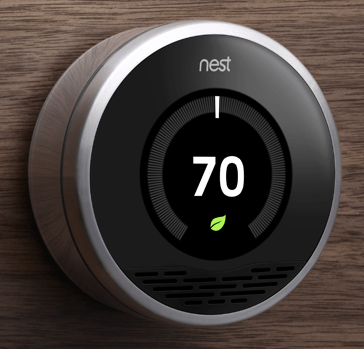
Screen Shot 2011 11 10 at 9 26 27 PM

But why the big embrace from so many? Because it’s pretty looking? Sure, to some degree. Because it begins to act like we think appliances should in 2011? No doubt. But I think there’s more. I think people are also applauding another company producing technology that also cares about aesthetics and simplicity. Unlike my current thermostats all of which have a beavy of buttons and switches and no intelligence, Nest’s thermostat has one dial and one button, a bunch of sensors, and two forms of connectivity.

Nest is a child of Apple and Steve. Twitter and Square are as well although less directly, and in mostly software. They are about delivering the critical functions for a service in a smart way, and reducing the “options” by making smart decisions. They are “designed”.

People are embracing that more than anything. I just replaced my doorbell switch. I used an inexpensive piece of junk. I’ve looked for doorbell switches and found quite few. Some seem wonderfully modern looking. Others have gee whiz LED lights. But for the cost, none of them did something that made me think this is worth the trouble it’s going to be to install. They didn’t take notice of where the average home owner would have to install the thing.

I want my washer and dryer to be able to send me a notification when they’re cycle’s are done. I want the water softener to tell me when it’s running low on salt. It’s 2011.

I watch houses get “stick” built the same way they were 100 years ago. Sure, a few products are different, but the techniques haven’t generally improved. There are better answers now. There are better systems* (see below). What is more simple than a house that doesn’t need a lot of heating or cooling? The change that we feel when we carry our smart phones is the change we want for all aspects of our lives. And it now up to the next generation of people who have experienced the effects of aesthetics and simplicity in design and the power it has for so many to take a leading role in changing the world with insanely great products. People have raised concerns about Apple’s future. I’m not concerned because there’s momentum there. People have resources and embedded knowledge. Apple will be fine for years. What’s more important to me is to see the same passion and care for design that goes into the Apple products now get going in other companies. And with Nest, it seems they are starting to do so.


* Bensonwood’s OBPlusWall: What sets Bensonwood apart is the attention to energy performance, green materials, and rigorous building science. At the heart of this system is the OBPlusWall (OB for “Open-Built”). These factory-built (panelized) walls are framed using 9.5-inch-deep I-studs filled with R-35 dense-pack cellulose insulation, then clad with exterior moisture-resistant OSB sheathing (with taped joints). Advanced gasket technology is used for air sealing, detailing is provided to minimize thermal bridging, a drainage plane is installed on the exterior, and integral baseboard raceways are provided on the interior for electrical and data cables to eliminate wall penetrations for wiring.

The computer modeling not only controls the exact design and fabrication of these wall panels, but even identifies the proper placement of nylon straps for hoisting the (heavy) modules into place on the jobsite. All this is done with a minimum of waste through material optimization and factory fabrication. OBPlusWall modules ship to the jobsite with windows installed and sometimes also with siding, though for some projects the builder chooses to handle more of the finish work on-site.
The companion to the R-35 wall system is a standard R-38 roof system, also insulated with cellulose. Where performance goals demand, Bensonwood can go a lot further with energy performance—by using deeper I-joists and including additional insulation components in the wall and roof systems.

Recently the company was finishing a house designed to Passive House standards. This walls will have an additional 3.5 inches of cellulose on the interior and two inches of polyisocyanurate on the exterior, to achieve approximately R-60 performance. That project was slowed down because advanced Passive House windows took some time to arrive from Germany—one of the complications with creating state-of-the-art buildings today.


PS I worked on a project with NYSERDA, at the energy company where I once toiled, to see if energy use behavior would change via smart meters that relayed the daily market fluctuations. The smart meters eliminated the “social” pricing we’re used to paying for energy. We pay the same price all day and night though the actual cost of energy fluctuates based on demand like any other commodity market. The idea was to find out whether people would react to this awareness and do the most energy expensive things when energy costs were lower. It was interesting, but ultimately didn’t carry enough information for people to make informed decisions. (You really needed to know how much something was going to cost. If I run the dishwasher now, what does that cost versus running it in the middle of the night?)

Sorry, Charlie

Sorry, Charlie: If you think you’ve found a flaw in an airport’s security checkpoint and demonstrate that by getting a harmless smoke bomb through and setting it off in the gift shop, you’ve definitely made your point, but spare us the expression of shocked surprise when the airport cops rush over to beat you with sticks instead of shaking your hand and showering you with flowers and chocolate.

[Well said.]
Source: Coyote Tracks

Open conversations (or close them)

Open conversations (or close them):

A guy walks into a shop that sells ties. He’s opened the conversation by walking in.

Salesman says, “can I help you?”

The conversation is now closed. The prospect can politely say, “no thanks, just looking.”

Consider the alternative: “That’s a [insert adjective here] tie you’re wearing, sir. Where did you buy it?”

Conversation is now open. Attention has been paid, a rapport can be built. They can talk about ties. And good taste.

Or consider a patron at a fancy restaurant. He was served an old piece of fish, something hardly worth the place’s reputation. On the way out, he says to the chef,

“It must be hard to get great fish on Mondays. I’m afraid the filet I was served had turned.”

If the chef says, “I’m sorry you didn’t enjoy your meal…” then the conversation is over. The patron has been rebuffed, the feedback considered merely whining and a matter of personal perspective.

What if the chef said instead, “what kind of fish was it?” What if the chef invited the patron back into the kitchen to take a look at the process and was asked for feedback?

Open conversations generate loyalty, sales and most of all, learning… for both sides.

[Of course, these simple examples (as important and relevant though they may be in context) are important as a lesson. Many of us get used to closing conversation. What if we were more open even if not directly related to our job? And the flip side. I’ve had many open conversations about a wide range of topics without anyone in the room telling me something important like “I’d prefer you work this way…” or “Why don’t you do more of this?”. Watch out for that…]
Source: Seth’s Blog

A Pattern Language

"When I was a child, I thought
God was disappointed
whenever some distraction interrupted...
Now I know that God expects such interruptions,
for He knows our frailty.
It is completion that surprises Him."

--From the God Whispers of Han Qing-jao

Noah loves playing with patterns. Colors, shapes, letters, lego pieces, alternation, similarity… the whole gamut.

But he also gets upset when for one reason or another he can’t complete a pattern the way he’d like. Lack of resources, lack of concentration. What have you. He likes a nice tidy world from that perspective (although not from many others…)

There’s much yet to teach.