NY Bottle Deposit for ‘water drinks’ Starts On Halloween

Bottle Deposit Starts On Halloween: Starting this coming Saturday, bottled water drinks will be subject to a nickel deposit—and the NY State government will be able to collect millions from the unclaimed deposits. Governor Paterson said, “The expansion of this legislation not only provides our State with much-needed revenue, but will also help us to keep our neighborhoods and parks clean.”

The law was supposed to go into effect in June, but some bottlers had argued that it was going into effect too soon, especially since NY State requires bottles sold here to have a special UPC. Which means some distribution and logistical issues; Environmental Leader points out, "For instance, a distributor can’t simply restock New York shelves with product from a New Jersey warehouse unless it bears the unique code."

The Post-Standard explains, “For consumers, the change is simple enough. Beginning at 12 a.m. Saturday, they will pay a nickel deposit on bottles of water, just as they do for soda and beer. They will get the deposits back when they return the bottles to the store or to a redemption center. Deposits will not be required on water that has sugar added, or on containers of 1 gallon or more.”

Distributors will have to give NY State 80% of all unclaimed deposits.

[This one is simple. Bottled water is bad idea. It always has been. I’ll admit that there a few times when bottled water makes sense. A few very special cases. Most of the time, tap water is fine. If you’re really super finicky, filter that as well. But by far most of the time plain old tap water carried in a reusable and hopefully recyclable or upcyclable container is the way to go. Lately the word is to watch out for BPA and linings made with BPA (metal cans, and some metal water bottles. Anyway… stop pretending that bottled water is worth the environmental impact of shipping this expensive and heavy item anywhere. We’re lucky that in most places in the US water is clean, healthy, and abundant. And save yourself needless tithing to the State. My disclaimer here is that as a hiker I’ve pulled water from sources that would make city folk vomit, although I did carry a filter and stuff (which never improves (ahem) brackish water), but did seem to keep me safe.]
Source: Gothamist

Outlier Tailored Performance (The Houndstooth Chronicles)

Outlier-winterhoodie-flat.jpg

I’m not sure where I came across Outlier, but I thought it was cool that couple guys in Brooklyn, were creating clothes for the tween space between on bike and off. It’s hard to make things work in both environments, it takes serious effort. I also dug that they were having the clothes made in NYC. I have some family connection to the “Shmata” trade, and I’m all for local sourcing and direct trade.

Occasionally they experiment with stuff publicly and make a few of an item. I think the first piece I grabbed was the Workwear Hoodie. The durable Workwear fabric ( Schoeller Dry Skin Extreme + Nanosphere) has worn extremely well. I haven’t taken any spills in it (thankfully) but it puts up with everything my rambuctious 4 year old can throw at it… Cookie and cracker crumbs, water, chocolate, miscellaneous dirt from goodness knows where have all rolled off. The fabric exterior is a canvas like nylon, and the inside a softish fleece that is warm and comfortable against the skin. It dries fast too, although it takes a lot to get it wet. The cut is clean and a bit smaller than is generally found in American brands. If you want to wear it with sweaters underneath order up. I find myself wearing this piece a lot as a spring/autumn jacket, and a layer through the winter. The helmet sized hood makes it a great piece to pair with a hoodless jacket. The Patagonia Nano Puff I recently started to wear leaps to mind. Awesome stuff.

outlier-nail-ltblue-profile.jpg

The next couple of pieces I ordered together. The Nailhead Cap and the Empire Merino Tee. I’ll go ahead and quote directly: “Nailhead is one of our favorite worsted wools around. Its subtle pinprick pattern gives it an incredible depth of texture, and as a fine suiting fabric it tends to be made from the softest and longest wool fibers available. That makes it one of the best performance fabrics in the world, but you’d never know since it tends to be used in expensive men’s suits and nothing but.” I can tell you that the cap is comfy, looks good whether I’m dressed down (as I usually am) in jeans and a sweater, or dressed up in a long wool coat. I’ve worn it every day since I got it. As with almost all hats, I could use a version where the crown to ear depth is shorter… but it’s close, close.

IMG_1285.JPG

I added the Empire T because Merino is darn comfortable. I love all the clothes I have that use this wonderful stuff, and the execution here is spot on. Yeah, in the end it’s an expensive T-Shirt, but it is one that you can wear as a base layer, or not. It’ll keep you cool and warm. It’ll do all that even if it gets wet… and it *doesn’t* become as odiferous as new fangled technical materials seem to. Wool is the original, and as far as I’m concerned most super, fabric. Properly chosen and tailored it’s perfect whether in a favorite houndstooth lightweight pant, a Filson Mackinaw jacket, or this excellent shirt. I only wish I could afford a passle of them.

I’d love to try some of the pants they’ve made, but I really need to try on pants since I have short legs, and prefer a short rise, especially on the bike. Maybe if I beg, Abe & Tyler will send me some…

Anyway, go check out there stuff. Designed and manufactured here in New York City with amazing fabric and materials. While they put out a “hipster” vibe, it’s not required. The designs are flexible enough to apply to us plain ole’ workin’ dads and our bikes.

OUTLIER-Empire-Tee.jpg

Google is Evil, Worse than PayPal: Don’t use Google Checkout for your business

Google is Evil, Worse than PayPal: Don’t use Google Checkout for your business: Don’t be evil’ my ass. So, to sum up our experience with Google Checkout:

they did not try to contact us to resolve any issue
there’s no way to find out why they closed our account, due to “security reasons”
there was no notice (we found out by accident, when we tried to pay for something with Google Checkout)
they kept over $200 of our money
there is no appeal
there is no one we can contact
we cannot open a new account
our money is gone, even though people have received their products
And I don’t know if you noticed, but that agreement section doesn’t actually have anything to do with this situation. It’s clearly just there to cause a sense of despair & make readers believe they have no legal recourse.[ They’re not the first people who have problems with Google’s position in the world. Google has too many policies like this, and it’s gotten very old. (An update.)]
Source: (24)Slash7

Workling, BackgroundJob, and some config file and UTC caution.

One of the features of the software I’m building is the ability to upload images and other binary files. Like so many other Rails apps we’re using attachment_fu. So far so good. We expected the “client” could pull these assets when they needed them and store them wherever they desired. And the developers rejoiced.

A follow up story required that we move those assets over to the website via SFTP. Since we use Capistrano I wrapped Net::SFTP (a Capistrano dependency). We wired it into the Model via after_save, and after_destroy, and again the developers rejoiced.

I decided to move the “hard coded” user, pass, etc. stuff to a config file, so created a YAML file and added the aforementioned sftp stuff, and some other application specific that was crufting up the place. I created an initializer to load the file, and again the… yeah, ok, you got it. Soon after there was some stuff that was environment specific so I created the 3 basic environment sections (development, production, and test) and moved along. I figured I could test for them in just one spot (for now) and all would be good. I’ve since had a change of heart, but no matter for now.

A short while later I accidently demo’ed the new transfer code with a very large image file, and was less than impressed by the way it went. Since Rails is single threaded (still, for the moment, although about to change as I write this) the file transfer absorbed copious resources on this somewhat long lived transfer. Genius that I am, I said we should run the transfer as a background process, and since I know we have other similar requirements coming up Real Soon Now(tm), decided to implement a queue as well. After looking around the landscape I decided on Workling and BackgroundJob. It looked like they would play nicely, and keep thing clean and straightforward.

In go the plugins, get things setup and migrated, create a worker class, and fire off the MyWorker.asynch_test_method. Cool! I see stuff in the database… hmmm nothing happened. I’m going to skip through the process at this point, and just discuss what we (I was pairing with Evan during most of this) found.

One of the recent changes in Rails (we started with 2.1 and have since moved to 2.1.2 as I write this) includes control over Time Zones. We had talked and played around with this a bit and decided that for our purposes UTC was just fine, and so left the default setting. Stuff in the database gets stored as UTC and when everything works as expected is converted to a local time setting, if you set one. Here’s the first gotcha. Since this is fairly new, folks have liberally sprinkled libraries with calls to Time.now(). Which is fine for what it is, but at least with the version of Ruby we’re using (1.8.6 as I write this) returns local time… but the database is living over in UTC land. I wouldn’t notice if my time zone was Greenwich Mean, but over here on the East Coast of the US there’s a five hour difference. So we hunted down (not for the first time mind you) the use of Time.now in the BJ runnner.rb an changed it to Time.now.utc. One bug down.

The next one was bug in the bj_invoker.rb that is installed by Workling in the script folder. Stuff happens (and a patch is being submitted) but there’s a bit of meta-programming going on, and it was hard to find the places where STDOUT was being nullified, and because it’s trying to act as background or async process, exceptions are being swallowed. So no significant logging, and no exceptions. In the end we patched the runner code in BJ to display STDERR and STDOUT, and we wrapped a method call in a begin/rescue in Workling to enable some exception logging at least in this common case.

Having done that we found our error, fixed our bugs, and watched everything work. And the developers rejoiced.

The lessons so far: Developers do not pay enough attention to time zones so watch for gotchas like how time is being stored in your database vs. how you test for time stuff. Secondly, only the main path will be well worn. All others will have bumps. Workling is commonly used with Starling and so using with other, even supported libs may be a somewhat more bug laden experience than one would hope for. This wasn’t too bad, but the process was methodically annoying and to a degree, orthogonal to our goals.

So… next we have the config file caution. So there’s this nice thing known as the Rails environment. It’s a beautiful thing as it makes it easy to separate development from testing and production. You can point each environment to a unique database. Excellent! You can change key settings about caching, and reloading of classes that makes development smoother and production faster. Yay! So what’s the caution? While those three are standard folks make up others. In addition to those three we have two others which are not common. They serve they’re purpose, but they’re not conventional.

Today I had a deploy fail. Hmm, that’s odd, they’re usually so smooth. Migration failed… nothing strange in there. Hmm there’s a couple of lines about config files… so what it turned out to be were two plugins that each rely on a config file. In one case the developers did the right thing and when they could not find a config file section that matched the environment, shut themselves down and wrote about it in the log. Excellent! The second was seriously hard wired to the config file, and so tossed an unhandled exception when it couldn’t find the matching environment section. Worse, the config file isn’t necessary for the setup we used, and the docs say it can be removed. (It can’t, for the same reason). So an unnecessary config file, missing an unnecessary environment hung my deploy. Sad. But it made me realize that I was missing those sections in my own little config file, so I added them in there as well, and have a card to rewrite the loading code to ensure that we always do the right thing if the environment section is not there.

A coupe more… it’s worthwhile in your Capistrano deploy stuff to be able to run migrations with –trace turned on. You should have matching environments on your development machine as you do elsewhere… I know I do… now. Lastly, as much as possible have a match to your production environment where you can make a mess without consequence. We use VMWare to slice up a hefty machine, and it’s a great tool for the purpose. It doesn’t hurt that we use Engineyard as our host and so can use the Express vm for testing.

Experience and thoughtfulness

Some people will never be considered “experienced”. To become experienced, one must reflect upon experiences and attempt to draw understanding from them. “This didn’t work out, this did. Hmmm? Why is that?” Failure to inspect our experiences leads no where.

You can also get ahead of the curve. “What do I think I should do in this situation? What am I capable of doing? where do they intersect? What does this more experienced and or capable person think? Does that change anything significant?” This is the nature of thoughtfulness.

So with these two simple notions at hand explain to me dear reader why no one pulled through on my ride this morning for over a 10 mile stretch into a headwind? I waved, I pulled out, I slowed… nothing. It’s was like watching one of the TDF breakaways falls apart where it has become everyone for themselves. Ya know, the guys in back never pull through? I would pull out and slow, everyone else would slow. I’d pull out and wave… nothing. Slowly extremely would bring questions of “Are you OK?”. Sigh. I’m fine. Keep pedaling! There was no reason someone else couldn’t stick their nose in the wind. A couple of folks were clearly being lazy, they had no problem sprinting ahead when they felt motivated. Quite a few had no problem pulling when we turned and the wind was longer in our faces. A couple of folks were probably inexperienced and haven’t been taught proper etiquette. Hopefully, they’ll go home and wonder about these moments and at least think “What was that about?”

ride_with_sheryl.png

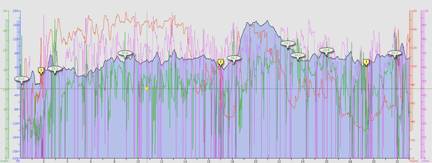
33 miles, almost 1000ft of climbing, an average speed of 13.4 that is really a lie ( well no, it’s not in the sense that I’m sure it is the average for all movement on the ride, but that includes the dinkying around the parking lots and city streets… so I pawed through the graph for the “on the road sections” and sure enough even the uphill averages were over 15 with some sections in the low 20’s.

The next annoyance was when I realized that a so called “expert”, an expert by virtue of nothing more than experience, put my wife’s bike rack together wrong, with some critical parts installed backward. My analysis is that in this case the person hasn’t built many of this model rack, and it was a misreading of the instructions, but I was surprised at how things went when I tried to put a bike on the rack. Something was wrong, but I couldn’t put my finger on it. Yesterday I saw a picture of the same rack and in just one second it became clear which parts had been installed wrong, and now it all makes far more sense, and works properly. The failure here is that someone who should be used to this (the so called expert) rushed the job. He should be used to working with customers waiting, he does it all the time. I was in no particular rush, and wasn’t hovering (on purpose). So it’s just sloppiness.

We can make a choice about the quality and nature of our work. We can be present and demand a level quality that we will not forego. To me it is essential to constantly be aware of this. I don’t always get to work to the quality level I wish, there are other constraints on my work such as time, cost, and my own ability to execute. What I cannot and do not give up is the awareness of those decisions, how they are made and why, and allow some lesser level than I desire become assumed and routine. I am aware of my decisions, my experience, and I will not release my thoughtfulness to the best of my ability.

Secrets of book publishing (and life!) Secrets of book publishing I wish I had known

Secrets of book publishing I wish I had known: Following up on these overviews of the book industry, I thought I’d share some lessons I learned from publishing Bit Literacy. I originally tried to go through mainstream publishers but eventually self-published it, because of what I learned in the process. I wish I had known everything below before I wrote my book. [I find similarities everywhere here… finding work or a job, finding gigs as a musician, working with local retail outlets, etc., etc. When it comes to people doing stuff, no one is interested in you but you. And if someone is interested (read, seemingly willing to help you), it is a sure sign that they see some way you can make them money, or help them, or generally for them to get something out of whatever they intend to do (see Frank Zappa). I don’t mean to sound so cynical, there’s a lot of cases where this isn’t true, and in fact I see nothing wrong with it. Understanding people’s motives means dealing honestly and openly. Pretending, misleading, or outright lying is far worse. Be up front about what you’re going to get and it’ll work out.]
Source: Good Experience Blog

Finding A Friendly Cloud

Finding A Friendly Cloud: Jason Hoffman, founder and chief technology officer of a cloud-computing specialist called Joyent, was particularly pointed in warning that Google’s App Engine could represent a lock-in to developers. It is possible to build “a loving cloud,” he argued, that would make it easier to create applications that could be easily moved among different services. Other panelists kept calling Google’s App Engine “proprietary,” which to many techies is equivalent to labeling it both evil and outdated at the same time. [Bring on the loving cloud, people. Bring it on!]

MacRuby

MacRuby is a version of Ruby 1.9, ported to run directly on top of Mac OS X core technologies such as the Objective-C common runtime and garbage collector, and the CoreFoundation framework. While still a work in progress, it is the goal of MacRuby to enable the creation of full-fledged Mac OS X applications which do not sacrifice performance in order to enjoy the benefits of using Ruby.

MacRuby is a free software project by Apple Inc. Sources are available under the Ruby license.

[It’s the last line I find so interesting. Also, that there are so many of these sorts of efforts taking place. IronRuby, now MacRuby, Rubinius, MagLev, etc. Great stuff for the Ruby world.]

No more space

Articles like this about the “Battle for Central Park”, where joggers and runners are forever aggravated at cyclists and vice versa, and everyone hates the car folks and vice versa, don’t speak to anything but extreme crowding.

The resources (open space, clear of “traffic” (defined as anything that interrupts *your* activity)) are too scarce. We are constantly jostling each other in our attempt to simply move about. Of course everyone is annoyed! Sadly though, there is a strong sense of entitlement and greed that runs as an undercurrent to the interactions.

I have no answers here, except for my personal one of making a choice to find more space for my family as quickly as possible.

Taking Things Apart

Taking Things Apart:

John August, asked by a working screenwriter how he can keep improving throughout his career:

My advice for you is to dedicate one day a week to disassembling good movies. Take existing films (and one-hour dramas) and break them down to cards. Think of yourself as an ordinary mechanic given the task of reverse-engineering a spaceship. Figure out what the pieces do, and why they were put together in that way.

I think this true for any craft.

[It’s a great way to hone one’s touch and grow new skills. I especially like doing it as a group exercise to learn what others see in something that I don’t.]
Source: Daring Fireball