New York May Require a Background Check to Buy a 3D Printer

New York May Require a Background Check to Buy a 3D Printer:

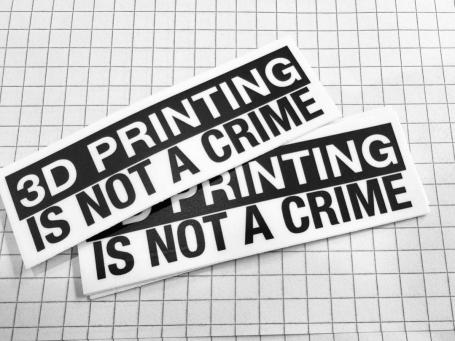
The New York bill, called AB A8132, would require a criminal history background check for anyone attempting to purchase a 3D printer capable of fabricating a firearm. It would similarly prohibit the sale of those printers to anyone with a criminal history that disqualifies them from owning a firearm. As it’s currently written, the bill doesn’t clarify what models or makes of printers would potentially fall under this broad category. The bill defines a three-dimensional printer as a “device capable of producing a three-dimensional object from a digital model.”

[I commented on Instagram… but of course, also here on the blog. I don’t disagree with the problem, but I do disagree with this attempt at solving it. It’s too broad…
]
396995882 912753713789115 7478371378068480989 n

FCC moves ahead with Title II net neutrality rules in 3-2 party-line vote | Ars Technica

FCC moves ahead with Title II net neutrality rules in 3-2 party-line vote | Ars Technica:

The Federal Communications Commission today voted to move ahead with a plan that would restore net neutrality rules and common-carrier regulation of Internet service providers.

In a 3-2 party-line vote, the FCC approved Chairwoman Jessica Rosenworcel’s Notice of Proposed Rulemaking (NPRM), which seeks public comment on the broadband regulation plan. The comment period will officially open after the proposal is published in the Federal Register, but the docket is already active and can be found here.

The proposal would reclassify broadband as a telecommunications service, a designation that allows the FCC to regulate ISPs under the common-carrier provisions in Title II of the Communications Act. The plan is essentially the same as what the FCC did in 2015 when it used Title II to prohibit fixed and mobile Internet providers from blocking or throttling traffic or giving priority to Web services in exchange for payment.

[Yeah baby!]

What’s the Deal with Summed-Input Stereo Effects? – Quilter Laboratories

What’s the Deal with Summed-Input Stereo Effects? – Quilter Laboratories:

Recently, there’s been a lot of controversy about effects that use summed stereo inputs vs. independent inputs. Obviously, nobody wants their stereo signal unintentionally collapsed to mono. So, effects with independent stereo inputs are clearly better, right? How has this gone unnoticed for decades and is only now exposed as a cost-cutting measure to cheat unsuspecting consumers?

Except, that’s not what’s happening here — not even close.

In this blog post, I will explain how stereo effects are designed, why they are designed this way, and the source of confusion around channel summing. I will also explain where channel summing might actually be desirable and where it’s not.

[Great article…]

AI Risks

AI Risks:

Beneath this roiling discord is a true fight over the future of society. Should we focus on avoiding the dystopia of mass unemployment, a world where China is the dominant superpower or a society where the worst prejudices of humanity are embodied in opaque algorithms that control our lives? Should we listen to wealthy futurists who discount the importance of climate change because they’re already thinking ahead to colonies on Mars? It is critical that we begin to recognize the ideologies driving what we are being told. Resolving the fracas requires us to see through the specter of AI to stay true to the humanity of our values.

One way to decode the motives behind the various declarations is through their language. Because language itself is part of their battleground, the different AI camps tend not to use the same words to describe their positions. One faction describes the dangers posed by AI through the framework of safety, another through ethics or integrity, yet another through security, and others through economics. By decoding who is speaking and how AI is being described, we can explore where these groups differ and what drives their views.

[Context!]