Some people will never be considered “experienced”. To become experienced, one must reflect upon experiences and attempt to draw understanding from them. “This didn’t work out, this did. Hmmm? Why is that?” Failure to inspect our experiences leads no where.
You can also get ahead of the curve. “What do I think I should do in this situation? What am I capable of doing? where do they intersect? What does this more experienced and or capable person think? Does that change anything significant?” This is the nature of thoughtfulness.
So with these two simple notions at hand explain to me dear reader why no one pulled through on my ride this morning for over a 10 mile stretch into a headwind? I waved, I pulled out, I slowed… nothing. It’s was like watching one of the TDF breakaways falls apart where it has become everyone for themselves. Ya know, the guys in back never pull through? I would pull out and slow, everyone else would slow. I’d pull out and wave… nothing. Slowly extremely would bring questions of “Are you OK?”. Sigh. I’m fine. Keep pedaling! There was no reason someone else couldn’t stick their nose in the wind. A couple of folks were clearly being lazy, they had no problem sprinting ahead when they felt motivated. Quite a few had no problem pulling when we turned and the wind was longer in our faces. A couple of folks were probably inexperienced and haven’t been taught proper etiquette. Hopefully, they’ll go home and wonder about these moments and at least think “What was that about?”
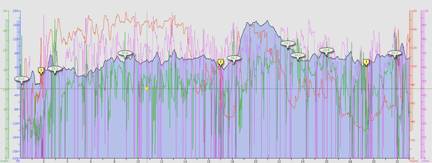
33 miles, almost 1000ft of climbing, an average speed of 13.4 that is really a lie ( well no, it’s not in the sense that I’m sure it is the average for all movement on the ride, but that includes the dinkying around the parking lots and city streets… so I pawed through the graph for the “on the road sections” and sure enough even the uphill averages were over 15 with some sections in the low 20’s.
The next annoyance was when I realized that a so called “expert”, an expert by virtue of nothing more than experience, put my wife’s bike rack together wrong, with some critical parts installed backward. My analysis is that in this case the person hasn’t built many of this model rack, and it was a misreading of the instructions, but I was surprised at how things went when I tried to put a bike on the rack. Something was wrong, but I couldn’t put my finger on it. Yesterday I saw a picture of the same rack and in just one second it became clear which parts had been installed wrong, and now it all makes far more sense, and works properly. The failure here is that someone who should be used to this (the so called expert) rushed the job. He should be used to working with customers waiting, he does it all the time. I was in no particular rush, and wasn’t hovering (on purpose). So it’s just sloppiness.
We can make a choice about the quality and nature of our work. We can be present and demand a level quality that we will not forego. To me it is essential to constantly be aware of this. I don’t always get to work to the quality level I wish, there are other constraints on my work such as time, cost, and my own ability to execute. What I cannot and do not give up is the awareness of those decisions, how they are made and why, and allow some lesser level than I desire become assumed and routine. I am aware of my decisions, my experience, and I will not release my thoughtfulness to the best of my ability.


 turnings :: daniel berlinger