Daring Fireball: 23andMe Confirms Hackers Stole Ancestry Data on 6.9 Million Users

Daring Fireball: 23andMe Confirms Hackers Stole Ancestry Data on 6.9 Million Users:

In an email sent to TechCrunch late on Saturday, 23andMe spokesperson Katie Watson confirmed that hackers accessed the personal information of about 5.5 million people who opted-in to 23andMe’s DNA Relatives feature, which allows customers to automatically share some of their data with others. The stolen data included the person’s name, birth year, relationship labels, the percentage of DNA shared with relatives, ancestry reports and self-reported location.

Here’s a real shocker: 23andMe has updated their terms of service in attempt to prevent a class action lawsuit. Good luck with that.

[I never trusted them…]
Introducing The Tech Stack File | StackShare

Introducing The Tech Stack File | StackShare:

Today we’re excited to launch a new open source file format – The Tech Stack File (techstack.yml). With input from the Cloud Native Computing Foundation (CNCF) leadership and project maintainers, our goal with this new file format is to create the universal standard for tech stack data to make it easier for teams everywhere to access, share, and gain insights from the full range of their technology data. To help the StackShare community leverage this new file format, we’re also announcing two new products: StackShare AI and StackShare Connect.

[Could be helpful… I guess we’ll see.]

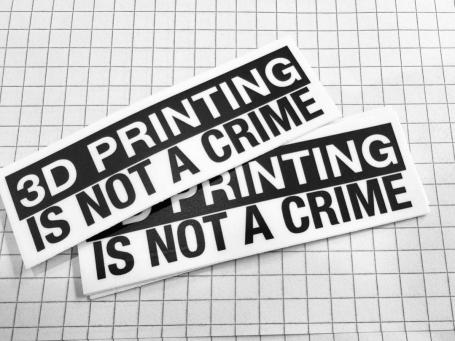
New York May Require a Background Check to Buy a 3D Printer

New York May Require a Background Check to Buy a 3D Printer:

The New York bill, called AB A8132, would require a criminal history background check for anyone attempting to purchase a 3D printer capable of fabricating a firearm. It would similarly prohibit the sale of those printers to anyone with a criminal history that disqualifies them from owning a firearm. As it’s currently written, the bill doesn’t clarify what models or makes of printers would potentially fall under this broad category. The bill defines a three-dimensional printer as a “device capable of producing a three-dimensional object from a digital model.”

[I commented on Instagram… but of course, also here on the blog. I don’t disagree with the problem, but I do disagree with this attempt at solving it. It’s too broad…
]

396995882 912753713789115 7478371378068480989 n

FCC moves ahead with Title II net neutrality rules in 3-2 party-line vote | Ars Technica

FCC moves ahead with Title II net neutrality rules in 3-2 party-line vote | Ars Technica:

The Federal Communications Commission today voted to move ahead with a plan that would restore net neutrality rules and common-carrier regulation of Internet service providers.

In a 3-2 party-line vote, the FCC approved Chairwoman Jessica Rosenworcel’s Notice of Proposed Rulemaking (NPRM), which seeks public comment on the broadband regulation plan. The comment period will officially open after the proposal is published in the Federal Register, but the docket is already active and can be found here.

The proposal would reclassify broadband as a telecommunications service, a designation that allows the FCC to regulate ISPs under the common-carrier provisions in Title II of the Communications Act. The plan is essentially the same as what the FCC did in 2015 when it used Title II to prohibit fixed and mobile Internet providers from blocking or throttling traffic or giving priority to Web services in exchange for payment.

[Yeah baby!]

What’s the Deal with Summed-Input Stereo Effects? – Quilter Laboratories

What’s the Deal with Summed-Input Stereo Effects? – Quilter Laboratories:

Recently, there’s been a lot of controversy about effects that use summed stereo inputs vs. independent inputs. Obviously, nobody wants their stereo signal unintentionally collapsed to mono. So, effects with independent stereo inputs are clearly better, right? How has this gone unnoticed for decades and is only now exposed as a cost-cutting measure to cheat unsuspecting consumers?

Except, that’s not what’s happening here — not even close.

In this blog post, I will explain how stereo effects are designed, why they are designed this way, and the source of confusion around channel summing. I will also explain where channel summing might actually be desirable and where it’s not.

[Great article…]

AI Risks

AI Risks:

Beneath this roiling discord is a true fight over the future of society. Should we focus on avoiding the dystopia of mass unemployment, a world where China is the dominant superpower or a society where the worst prejudices of humanity are embodied in opaque algorithms that control our lives? Should we listen to wealthy futurists who discount the importance of climate change because they’re already thinking ahead to colonies on Mars? It is critical that we begin to recognize the ideologies driving what we are being told. Resolving the fracas requires us to see through the specter of AI to stay true to the humanity of our values.

One way to decode the motives behind the various declarations is through their language. Because language itself is part of their battleground, the different AI camps tend not to use the same words to describe their positions. One faction describes the dangers posed by AI through the framework of safety, another through ethics or integrity, yet another through security, and others through economics. By decoding who is speaking and how AI is being described, we can explore where these groups differ and what drives their views.

[Context!]

Musk’s process

I find Musk very off-putting to say the least. But I still think this processis worth considering. (From Walter Isaacson’s book)

  1. Question every requirement. Each should come with the name of the person who made it. You should never accept that a requirement came from a department, such as from “the legal department” or “the safety department.” You need to know the name of the real person who made that requirement. Then you should question it, no matter how smart that person is. Requirements from smart people are the most dangerous, because people are less likely to question them. Always do so, even if the requirement came from me. Then make the requirements less dumb.
  2. Delete any part or process you can. You may have to add them back later. In fact, if you do not end up adding back at least 10% of them, then you didn’t delete enough.
  3. Simplify and optimize. This should come after step two. common mistake is to simplify and optimize a part or a process that should not exist.
  4. Accelerate cycle time. Every process can be speeded up. But only do this after you have followed the first three steps. In the Tesla factory, I mistakenly spent a lot of time accelerating processes that I later realized should have been deleted.
  5. Automate. That comes last. The big mistake in Nevada and at Fremont was that I began by trying to automate every step. We should have waited until all the requirements had been questioned, parts and processes deleted, and the bugs were shaken out.

How Apple made the ultimate Snoopy watch: “You wouldn’t believe the minutiae”

How Apple made the ultimate Snoopy watch: “You wouldn’t believe the minutiae”:

That first meeting at the Charles M Schulz Museum in Santa Rosa, California, was the Watch team’s first in-person meet-up after the pandemic, and what started as a two-hour drive north from Mountain View ultimately ended with plans for 148 unique animations that would be contextual depending on the time of day, local weather and activities. When you go for a swim, Snoopy dons his scuba gear and floats through your watch screen. When night arrives he’ll howl at the moon, and when you’re not up to much at all you can find him draped over his iconic red doghouse in a series of panels that are a direct lift from the comics. It all amounts to over 12 minutes of animation work that stemmed from an unexpectedly chaotic tête-à-tête.

“I’m typically a very organised person,” says Gary Butcher, human interface designer at Apple. “So I felt, ‘We’ve got a limited amount of time together and there might be some uneasiness, so I’ll print out 148 pieces of blank paper and we need to leave the room having filled out every one of those pages.’ By the end of the day, we’d not touched the wall of A3 paper, but had tons of sketches littering the table.”

[This. Is. So. Good!!!]

Snoopy watch faces 1 jpg