Merb 1.0 Released So Here’s 44 Links and Resources To Get You Going

Merb 1.0 Released So Here’s 44 Links and Resources To Get You Going:

merb.pngMerb – a much heralded, highly flexible Ruby-based Web application framework – has reached version 1.0 after two years of development. Congratulations to Merb’s creator, Ezra Zygmuntowicz, and to the large group of associated developers (such as Yehuda Katz and Matt Aimonetti) who’ve kept adding features and pushed Merb forward to be a significant alternative to Rails.

Ruby Inside has been some surveys for the past couple of months, and they still show that only 25% of Ruby Inside’s visitors have ever developed a Merb application. With the stability that the 1.0 release offers (older versions of Merb had a reputation – fair or not – for a constantly shifting API), it’s now a great time to give Merb a try. It’s also a great time to get into writing tutorials and documentation!

Quick Start

Install Merb from Rubyforge: gem install merb

If you’d rather go from Merb’s “edge” repository: gem install merb –source http://edge.merbivore.com

NOTE: Make sure that you are running RubyGems 1.3.0 or higher (run gem -v to check). If not, you need to upgrade (I found this page very useful for doing that.

Then follow a tutorial such as Life On The Edge with Merb, DataMapper & RSpec, Slapp: A Simple Chat Wall Merb Tutorial or Move Over Rails. Here Comes Merb.

Once you’re ready to roll, bookmark this page for safe keeping and read on for our Merb resources! We’ve divided them up into sections to make it easier. Some will also be left in the comments by other readers!

Merb News and Community Sites

merbunity.png

Merbunity – A community news site that focuses entirely on Merb. So far it’s not been updated particularly often, but this is likely to change, and what they do have is great.

Merbivore – The official Merb homepage. It provides links to all of the major things you’d need – docs, a wiki, downloads, and information on how to help the Merb project.

merboverheard.png

Merb Overheard – A “planet” / aggregation blog for Merb related content. It also features some of the latest Merb related Twitter messages. A good looking site and well worth following if you want to stay up to date on Merb news.

Planet Merb – A “planet” site for Merb-related blogs. Currently only has the blogs of several Merb developers and the official Merb blog, but it’s bound to grow over time.

The Merbist – A Ruby Inside-esque blog for the Merb world. It’s run by Matt Aimonetti, a Merb core team member. Well worth subscribing to if you want a look at high level news related to Merb.

Merb Google Group – A Google Groups hosted mailing list for Merb developers. It has over 800 members and is pretty busy!

#merb on irc.freenode.net – Not a Web link, but an IRC channel. If you want to chat live about Merb but aren’t familiar with IRC, learn more here.

Ezra Zygmuntowicz’s Brainspl.at – The personal blog of Merb creator, Ezra Zugmuntowicz. A lot of it is Merb related in some way or another.

Katz Got Your Tongue? – The personal blog of Yehuda Katz, a key Merb developer and evangelist. A lot of Merb related posts.

Merb Tutorials and Documentation

Note that some tutorials may be slightly out of date or use features that have changed in Merb 1.0. Use these tutorials as a guide, not as canon (for that, you’ll want a book, see next section).

The Merb Book: Life On The Edge With Merb, Datamapper & RSpec – An online book started by the guys of London development team, New Bamboo, but now contributed to by many Merb developers. It’s very indepth and changing over time. There’s definitely no lack of detail here.

Merborial: Getting Started with Merb and DataMapper – A simple and straightforward tutorial by Chris Kaukis.

Move Over Rails. Here Comes Merb. – A tutorial by Mark Watson that demonstrates how to create a “planet” type Ruby blog aggregator using Merb. Very complete – doesn’t include Ruby Inside though? Heresy!

Relax with Merb and CouchDB – A very clean and to the point guide by Paul Carey on developing a Merb application that uses CouchDB for the DB backend (using RelaxDB).

7 Merb Questions Answered – Justin Pease answers some Merb related questions. How to access environment variables, partial rendering, how to use HAML, how to start in production mode, how to log data, and how to get the current URL in a view.

Slapp: A Simple Chat Wall Merb Tutorial – SocialFace presents a great tutorial on how to use Merb to develop a basic “chat wall” application. If you’d rather just look at the resulting code, check out the Slapp Git repository.

Merb + Shoes = Interesting Web / GUI App Crossovers – Gregory Brown and Brad Ediger wrote a six page tutorial on how to develop a cross-platform GUI app using Shoes and Merb on the backend.

Multi Environment Merb+DM Deployment with Vlad+Git – Corey Donohoe (a.k.a. atmos) demonstrates how to use Vlad and Git to deploy your Merb apps.

MerbCamp Videos – Videos of all of the main sessions from MerbCamp. Lots of awesome stuff to watch here on how to write Merb plugins, how to deploy a Merb app, Merb primers, DataMapper tutorial sessions, how to migrate from Rails to Merb, and more!

MerbAuth – The Basics – An excellent overview of the MerbAuth authentication framework and how to use it to perform authentication in your Merb app.

Merb Books

mia.png

Merb in Action – A general Merb book being written by Michael Ivey, Yehuda Katz, and Ezra Zygmuntowicz. It’s not due out in print till May 2009, but so far three chapters are available in PDF form via an “Early Access Edition” right now. With the soldier on the cover, I guarantee this will end up being called the “MIA” or “Soldier” book :)

The Merb Way – Following in the mold of the awesome The Ruby Way and The Rails Way books will come The Merb Way by Foy Savas. Publishing date is still uncertain, but likely to be next year. Given the history of Addison Wesley’s * Way series, I expect this will be a gigantic reference book spilling out all of the guts of Merb for us to see and enjoy.

Beginning Merb – Apress continue their Beginning * series with a Merb entry. Due out in February 2009, it’ll be about 500 pages in length.

Merb Sample Apps

Feather – An “uber lightweight” Merb blogging engine / system. A blog is always a great app to take inspiration from :)

Panda: Open source video platform – An open source video transcoding and streaming platform built mostly around a Merb app.

PmpknPi – A RESTful Blog API written in Merb.

Slapp – A “chat wall” Web app.

Merb-OpenID-Example – An example OpenID consumer application written in Merb using merb-auth’s OpenID functionality.

merb_mart – An open source e-commerce engine built on Merb.

merb-dm-couchdb-sample – A quick sample application showing how to use CouchDB with a Merb / DataMapper app.

Merb Events

merbcamp.png

MerbCamp – MerbCamp was the first official gathering for the Merb community, but it’s likely to happen again next year, so make sure you keep your eyes peeled for it. Also be sure to watch the videos of the MerbCamp presentations.

Merb Outpost – A London based “outpost” of MerbCamp where 29 Merbists watched MerbCamp on a live webfeed. I’d be surprised if they didn’t try to revive this for the next MerbCamp. If you’re in London and want to be in contact with other local Merbists, however, get on there and check them out.

Merb Miscellaneous

FiveRuns TuneUp for Merb – FiveRuns is a leading provider of monitoring and development products for Ruby on Rails and other popular open source and commercial systems. They’ve got a version of their performance tuning and debugging tool, TuneUp, available for Merb developers.

Google Tech Talk: Merb, Rubinius and the Engine Yard Stack – Ezra Zygmuntowicz gave a tech talk to Googlers on Merb and Rubinius. This is very new and well worth watching for its full 47 minutes.

A Quick Jaunt Through Merb’s Framework Code – Ezra Zygmuntowicz presents a tutorial for those who want to see how a request travels through the Merb framework in its quest to get a proper response. Some nice indepth stuff here.

Merbcamp – notes from the edge – Some excellent notes taken based on what happened at Merbcamp.

Authlogic – A framework agnostic authentication system that works well with Merb. Get awesome authentication on your Merb app – fast.

Merb on RubyForge – All of the Merb libraries and gems directly from RubyForge.

Merb on Github – All of the Merb libraries collectively within a Git repository on Github.

DataMapper – While Merb forces no specific ORM on you, DataMapper has become the de facto standard when developing Merb applications. Learn more about it here.

Merb TextMate bundle – A Merb bundle for TextMate by Dr Nic Williams.

Merb_global – Localization and internationalization support for Merb. Experimental.

merb_cucumber – A library offering Cucumber (a BDD testing tool) integration with Merb.

21 Merb Links, Tutorials and Other Resources – A set of Merb resources on Ruby Inside from February! Might still be some stuff worth checking out in there. It’s a real bran tub of Merb delights.

Why Engine Yard, Rubinius and Merb Matter – Antonio Cangiano looks at some of the motivation behind Engine Yard’s progress on Merb and Rubinius.

Got any more Merb resources? Please leave a comment!

[This was too good not to repeat…]
Source: Ruby Inside

It can be geared, or single speed…

jones_ebb.jpg BTW, All these pictures are from the designer/builder, who is taking the time to bring the frame into the light, snap a few pictures, and email to them me… which I greatly appreciate. Thanks Jeff! So much frame, so little patience left at this point! Below, a bit of the fork, and a bit of the carbon fiber steerer tube…bit_of_truss_cf_steerer.jpg

Workling, BackgroundJob, and some config file and UTC caution.

One of the features of the software I’m building is the ability to upload images and other binary files. Like so many other Rails apps we’re using attachment_fu. So far so good. We expected the “client” could pull these assets when they needed them and store them wherever they desired. And the developers rejoiced.

A follow up story required that we move those assets over to the website via SFTP. Since we use Capistrano I wrapped Net::SFTP (a Capistrano dependency). We wired it into the Model via after_save, and after_destroy, and again the developers rejoiced.

I decided to move the “hard coded” user, pass, etc. stuff to a config file, so created a YAML file and added the aforementioned sftp stuff, and some other application specific that was crufting up the place. I created an initializer to load the file, and again the… yeah, ok, you got it. Soon after there was some stuff that was environment specific so I created the 3 basic environment sections (development, production, and test) and moved along. I figured I could test for them in just one spot (for now) and all would be good. I’ve since had a change of heart, but no matter for now.

A short while later I accidently demo’ed the new transfer code with a very large image file, and was less than impressed by the way it went. Since Rails is single threaded (still, for the moment, although about to change as I write this) the file transfer absorbed copious resources on this somewhat long lived transfer. Genius that I am, I said we should run the transfer as a background process, and since I know we have other similar requirements coming up Real Soon Now(tm), decided to implement a queue as well. After looking around the landscape I decided on Workling and BackgroundJob. It looked like they would play nicely, and keep thing clean and straightforward.

In go the plugins, get things setup and migrated, create a worker class, and fire off the MyWorker.asynch_test_method. Cool! I see stuff in the database… hmmm nothing happened. I’m going to skip through the process at this point, and just discuss what we (I was pairing with Evan during most of this) found.

One of the recent changes in Rails (we started with 2.1 and have since moved to 2.1.2 as I write this) includes control over Time Zones. We had talked and played around with this a bit and decided that for our purposes UTC was just fine, and so left the default setting. Stuff in the database gets stored as UTC and when everything works as expected is converted to a local time setting, if you set one. Here’s the first gotcha. Since this is fairly new, folks have liberally sprinkled libraries with calls to Time.now(). Which is fine for what it is, but at least with the version of Ruby we’re using (1.8.6 as I write this) returns local time… but the database is living over in UTC land. I wouldn’t notice if my time zone was Greenwich Mean, but over here on the East Coast of the US there’s a five hour difference. So we hunted down (not for the first time mind you) the use of Time.now in the BJ runnner.rb an changed it to Time.now.utc. One bug down.

The next one was bug in the bj_invoker.rb that is installed by Workling in the script folder. Stuff happens (and a patch is being submitted) but there’s a bit of meta-programming going on, and it was hard to find the places where STDOUT was being nullified, and because it’s trying to act as background or async process, exceptions are being swallowed. So no significant logging, and no exceptions. In the end we patched the runner code in BJ to display STDERR and STDOUT, and we wrapped a method call in a begin/rescue in Workling to enable some exception logging at least in this common case.

Having done that we found our error, fixed our bugs, and watched everything work. And the developers rejoiced.

The lessons so far: Developers do not pay enough attention to time zones so watch for gotchas like how time is being stored in your database vs. how you test for time stuff. Secondly, only the main path will be well worn. All others will have bumps. Workling is commonly used with Starling and so using with other, even supported libs may be a somewhat more bug laden experience than one would hope for. This wasn’t too bad, but the process was methodically annoying and to a degree, orthogonal to our goals.

So… next we have the config file caution. So there’s this nice thing known as the Rails environment. It’s a beautiful thing as it makes it easy to separate development from testing and production. You can point each environment to a unique database. Excellent! You can change key settings about caching, and reloading of classes that makes development smoother and production faster. Yay! So what’s the caution? While those three are standard folks make up others. In addition to those three we have two others which are not common. They serve they’re purpose, but they’re not conventional.

Today I had a deploy fail. Hmm, that’s odd, they’re usually so smooth. Migration failed… nothing strange in there. Hmm there’s a couple of lines about config files… so what it turned out to be were two plugins that each rely on a config file. In one case the developers did the right thing and when they could not find a config file section that matched the environment, shut themselves down and wrote about it in the log. Excellent! The second was seriously hard wired to the config file, and so tossed an unhandled exception when it couldn’t find the matching environment section. Worse, the config file isn’t necessary for the setup we used, and the docs say it can be removed. (It can’t, for the same reason). So an unnecessary config file, missing an unnecessary environment hung my deploy. Sad. But it made me realize that I was missing those sections in my own little config file, so I added them in there as well, and have a card to rewrite the loading code to ensure that we always do the right thing if the environment section is not there.

A coupe more… it’s worthwhile in your Capistrano deploy stuff to be able to run migrations with –trace turned on. You should have matching environments on your development machine as you do elsewhere… I know I do… now. Lastly, as much as possible have a match to your production environment where you can make a mess without consequence. We use VMWare to slice up a hefty machine, and it’s a great tool for the purpose. It doesn’t hurt that we use Engineyard as our host and so can use the Express vm for testing.

Just one more layer… one more layer.

Leaves begin to change color along the Swift River in the White Mountain National Forest in Albany, N.H., Wednesday, Oct. 1, 2008.(AP Photo/Jim Cole)So it’s looking a lot like this (an AP photo by Jim Cole) around here these days. The days are bright with autumn sunshine, the air is crisp and clean. I can’t say enough about this time of year… except when I get up to ride at 5:30am. This morning it was 32 degrees F… also known as freezing. And a bit breezy. The problem is that after a few hours it can be significantly warmer out, and you need to figure the layers and compressibility, so that you might be able to shed something later, and stick in a pocket.

This morning I guessed wrong. And I payed the price. We had a nice route going, where there is this nice steady climb. Especially this time of year, it kicks my butt. But that’s what I’m out there for, so that was fine. Sure, Gerry felt the need to inquire of my plans for succession at the top of a long climb, but fear not. I’ve been there before, just not quite under dressed for the weather like today.

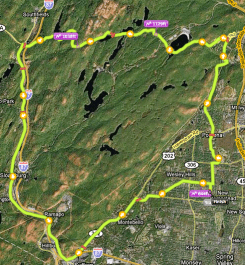
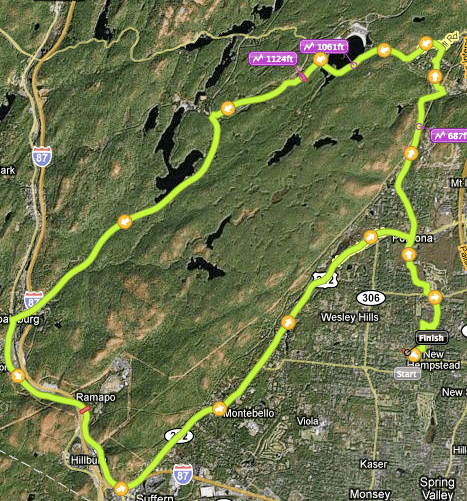
nov_2_gerry_route.pngThe kicker is when I dress too lightly and then climb, it costs me. First, I’m cold starting the climb. I feel weak and small. Then I warm up, and start to sweat. All fine until you reach the usually joyful downhill. Now it’s just freezes that sweat to your body, and makes you feel exceptionally cold. In more serious weather it’s a great way to get hypothermic. Today, it was just annoying, but made me cut my intended ride short. I did find a balance again when we took a short break and I stood in the sun for a few minutes. The rest, the sun, and then a nice pace brought me back to comfortable enough, but the ride had been long enough and uncomfortable enough that I didn’t feel like continuing. 24 uncomfortable miles. Here’s the thing. Despite all the whining and all about my screwing up a ride, it was a glorious fall day for ride. The light is amazing, the leaves are spectacular, the neighborhoods we ride through are well kept and quaint. The folks I ride with all the time always have interesting topics and trivia to discuss, and never seem to have an agenda about well, just about anything on the rides. Just one more layer… one more layer.

(Two other mistakes I made today… thinking it would be warmer since it was “an hour later”, and “I should be wide awake” since it was “an hour later”. Not so much on either count.)

A Sunday ride

ramble.pngA bunch of friends got together to ride on a glorious fall day. I met Gerry early to get in some additional miles, and as always, appreciate his experience and insight. Gerry, for all the teasing he takes is a remarkable athlete who has ridden well over 100,000 miles this decade. And that doesn’t begin to include his running or anything else. Fortunately for me Gerry is an early riser, and since I almost always have to ride early in the day, I can often catch up with him somewhere, and often he’s already been riding for a while. I’m not sure how far he had gone this morning before he met with me, but I had layered up and was ready. We spun out and had a nice pre ride spin, and caught up a bit. He’s been competing in a number of events and doing rather well.

Back at Piermont, I said hello to the guys, checked up on a couple of little things and then headed out with the group. A lovely bunch of folks, including one person who has been rehabbing for a while and is finally back on their bike, and in a related way I learned that someone who I’ve known for a while (just as smartest and lovely person as you could wish to meet, Hi Rita!) lives around the corner from me. I can’t begin to count how many times I must have ridden by her house.

Anyway, today was the perfect day for a rambling ride, enjoying the beautiful fall light, the leaves, and the crisp clean air. Add a great bunch of folks… and it’s magic.

I also completely ripped up two town line sprints after getting toasted by Jenni with the excuse that (wait for it…) I didn’t know we were competing until after she blew by me.

And below… one more piece of soon to be acquired winter gear… although I intend to get the 183 version for the front.

avid_bb7_road_08_m.jpg

Caged kings, King cages

fall_autumn_peartree.pngDelicious autumn! My very soul is wedded to it, and if I were a bird I would fly about the earth seeking the successive autumns.
~George Eliot

I continue to prepare for the winter biking season. It can be very hard to get out 5:30am on a Sunday morning this time of year. It’s dark, it’s cold, and generally not pleasant. Worse, you know it’s going to be much warmer and brighter later… when I can’t usually ride because of other obligations. That leaves me with a mostly mental battle — like my ride yesterday started out at 36 degrees F. Still some actual preparation takes place… I changed wheels on my road bike to a stronger wheel with rubber that has a bit more tread to it on the corners. The strength comes in handy hopping over fallen branches etc. The next step is over to the truly fat road tires (which requires a change of bike — heh). Clothing got sorted and cleaned. Gloves have gone from fingerless, to light, to medium. We’ve quickly blown through arm and leg warmers in the early morning, that season has passed already for me. But all in all, it’s mostly getting ready for the freezing cold starts, and often colder feeling finishes. It’s also remembering to bring something to blow one’s nose with, and taking a moment now and again to do so. That makes cold weather riding far more comfortable for me.

Below, a new set of King cages, featherweight titanium bottle cages made from “left over” titanium tubing from the airline industry. Light, strong, and they don’t markup one’s bottles, and further, match the “weapon of choice::winter division” very nicely. Coming soonish now… one hopes.

king_cages.pngBittersweet October. The mellow, messy, leaf-kicking, perfect pause between the opposing miseries of summer and winter.
~Carol Bishop Hipps

Autumn

pumkin_panarama_2008.png
We have few “we-started-them” family traditions. Family traditions abound on both sides, but there are few we feel are our own. Apple/Pumpkin picking is one. Even that is fairly hazy in that everyone else has done it as well, but we try and do it every year which apparently counts for something somewhere, in some ledger of family tradition, or so I’m told, and leave me alone already etc.

Fruit off a tree is magical. It’s not from a bin in a store. It’s not handled by others. It’s not processed, folded, spindled, or mutilated as the post office is want to say. One second it’s part of tree and the next second it’s a snack, or a pie, or the promise of one. Magic I tell you.
IMG_0607.jpg

IMG_0608.jpg
Noah agrees.

External git merge on OS X

External git merge on OS X:

The default merging behavior of git is pretty good – until it blows chunks and litters your merged file with dozens of >>>> markers. I had this happen to me again this weekend, and was finally motivated to do something about it.

[snip]

sudo port install xxdiff
git config –global merge.tool xxdiff

Now files needing a merge will open in the xxdiff user interface – which is an ugly XWindows thing, but it’s powerful. I’d love to see git hook up to something like Araxis Merge or Changes (when their 2.0 version with 3-way merge comes out), but I’m not nearly motivated enough to hack around in the git source yet.

[I’m not happy with ports. Each attempt leaves me with a mess I have to clean up myself. Any other solutions?]
Source: A Fresh Cup – Home

Railing away…

So say what you will about the value of your web framework of choice, but I and someone I work with (who never used this particular framework) built a useable section of an app and deployed to production in two weeks. Now we had some advantages. We had worked together before for about 8 months. My partner is really smart. I have some experience with the framework. Things that were working against us. We had very little time to produce the first useable bit of functionality. We don’t have our dev environment set up. We don’t have the proper test and QA structure in place yet and we were using a significantly advanced version of the framework since the last bit of development I had done with it.

Still, Ruby on Rails and it’s community is powerful stuff. A couple of plugins, a bit of spelunking via Google, and our own understanding of web frameworks made it possible to crank out some great stuff. Even now, as we start week 4, the code is getting tighter and more Ruby like. I can’t wait to see where we’re at in six months and beyond.

It’s been amazing.

Some common stuff we’re enjoying:

acts-as-taggable-on
newrelic_rpm
restful_authentication
rspec
rspec_on_rails
will_paginate

Thanks to the community for solving so many problems in advance.

Allez!

We’re looking forward to getting some of our solutions and ideas written up and coded for more general use. We have a public repository, and as soon as we can, we hope to start giving back.