Of pens and swords

In the other haptic interface, a single hand lightly holds a goose feather dipped in ink. This tool makes use of no bold physical gestures and in fact ceases to work if the user’s body is in motion. Much like the touchscreen interfaces that Bret Victor frets about, this goose feather forces the user to a limited range of gestures with just one hand. And the output is only words.

As for the comparison: someone famously wrote about which of these interfaces is mightier.

Moving into the future, interaction designers should remember that simple interfaces are often the best. More importantly, the true worth of an interface is often expressed by how it fits into the world. (Microsoft’s vision of the future: more sloppy info provides a good example.) Don’t get too wrapped up in tactical details or new features. The best experience in the future may very well come from something old and mighty.

[And continuing my own theme, people love when technology fades into the distance. When things “just work”. If it doesn’t do that, it’s not what it should be.]
Source: Good Experience Blog

Of iPhones and Thermostats, a legacy has begun

Today Nest ships their first product. It’s a thermostat that is essentially a smart phone tied to your heating/cooling systems, with a some sensors and the ability to learn. It learns when you turn the temps up and down, how often you walk by it when you’re home, how quickly or slowly your home heats and cools and most likely some other things. They sold out of 4 months of production in 72 hours.

Earlier this week, I had to bring my phone in to get it swapped out. And while at this backwater little Apple store ay 9AM I again saw the line outside for people purchasing the iPhone 4S five weeks after its initial release. I’ve seen this by every store I’ve been in or walked past. Two in New York City, one in Westchester County, One in Rockland County and this one in NJ.
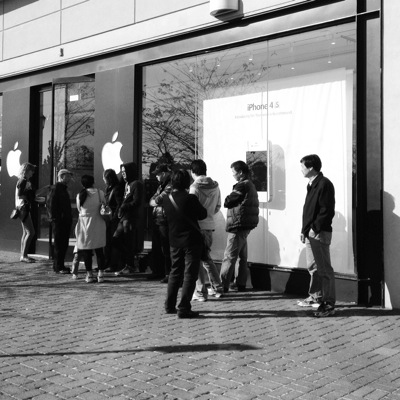
4S queue outside of an Apple store

Nest was started by an Apple alum, and was a designer there for 9 years. The guy worked on the iPods, iPhones, and in a sense because they share internals the iPad. And having absorbed the design and manufacturing culture of Apple he essentially would have it no other way at his new company. That isn’t easy—his relatively little company cannot command the scale and resources that Apple routinely does as part of their strategy for success.

I have a bunch of thermostats in my house. When we moved in I changed them to “set back” thermostats—they are “programmable” and so allow you to adjust energy use automatically based on the time of day and day of the week. Sadly, in my house, the heating and air systems are completely separate. And worse there are additional individual heat systems as well. So it goes a little something like this…

There’s three zones for the main hydronic heat. Two upstairs (bedrooms vs. living area/dining room) and another zone downstairs in the spare bedroom. There’s a radiant system in the kitchen, although it turns out to be more for joy than because the kitchen needs the heat. We didn’t know when we redid the kitchen and pulled out the main system heat, so we didn’t risk having a cold, uncomfortable kitchen. There’s also a gas fireplace downstairs that serves two purposes. It adds warmth and joy to the play room where again we pulled out the main system heat. It also runs when there is no power so that room because *the* living space when power goes out for any length of time. Lastly the central air conditioning system is single zone and on its own thermostat.

That’s six thermostats, three systems and two pumps. And while some careful programming makes it all work, the system is not smart, it can’t react to change. What I’d really like is main control that is informed that we’re home and our desired temp is x this time of year. Also, obviously the related settings for when we’re not home, and when we arrive home so that it can start warming or cooling the house in advance. It should also know the outside temp, so it can adjust to changing conditions. It would be nice if nest can manage all this… and maybe it can now, but I have no idea as of yet. And no, I haven’t ordered one, the current model may not help with this overall problem.
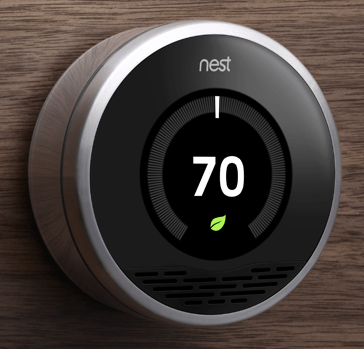
Screen Shot 2011 11 10 at 9 26 27 PM

But why the big embrace from so many? Because it’s pretty looking? Sure, to some degree. Because it begins to act like we think appliances should in 2011? No doubt. But I think there’s more. I think people are also applauding another company producing technology that also cares about aesthetics and simplicity. Unlike my current thermostats all of which have a beavy of buttons and switches and no intelligence, Nest’s thermostat has one dial and one button, a bunch of sensors, and two forms of connectivity.

Nest is a child of Apple and Steve. Twitter and Square are as well although less directly, and in mostly software. They are about delivering the critical functions for a service in a smart way, and reducing the “options” by making smart decisions. They are “designed”.

People are embracing that more than anything. I just replaced my doorbell switch. I used an inexpensive piece of junk. I’ve looked for doorbell switches and found quite few. Some seem wonderfully modern looking. Others have gee whiz LED lights. But for the cost, none of them did something that made me think this is worth the trouble it’s going to be to install. They didn’t take notice of where the average home owner would have to install the thing.

I want my washer and dryer to be able to send me a notification when they’re cycle’s are done. I want the water softener to tell me when it’s running low on salt. It’s 2011.

I watch houses get “stick” built the same way they were 100 years ago. Sure, a few products are different, but the techniques haven’t generally improved. There are better answers now. There are better systems* (see below). What is more simple than a house that doesn’t need a lot of heating or cooling? The change that we feel when we carry our smart phones is the change we want for all aspects of our lives. And it now up to the next generation of people who have experienced the effects of aesthetics and simplicity in design and the power it has for so many to take a leading role in changing the world with insanely great products. People have raised concerns about Apple’s future. I’m not concerned because there’s momentum there. People have resources and embedded knowledge. Apple will be fine for years. What’s more important to me is to see the same passion and care for design that goes into the Apple products now get going in other companies. And with Nest, it seems they are starting to do so.


* Bensonwood’s OBPlusWall: What sets Bensonwood apart is the attention to energy performance, green materials, and rigorous building science. At the heart of this system is the OBPlusWall (OB for “Open-Built”). These factory-built (panelized) walls are framed using 9.5-inch-deep I-studs filled with R-35 dense-pack cellulose insulation, then clad with exterior moisture-resistant OSB sheathing (with taped joints). Advanced gasket technology is used for air sealing, detailing is provided to minimize thermal bridging, a drainage plane is installed on the exterior, and integral baseboard raceways are provided on the interior for electrical and data cables to eliminate wall penetrations for wiring.

The computer modeling not only controls the exact design and fabrication of these wall panels, but even identifies the proper placement of nylon straps for hoisting the (heavy) modules into place on the jobsite. All this is done with a minimum of waste through material optimization and factory fabrication. OBPlusWall modules ship to the jobsite with windows installed and sometimes also with siding, though for some projects the builder chooses to handle more of the finish work on-site.
The companion to the R-35 wall system is a standard R-38 roof system, also insulated with cellulose. Where performance goals demand, Bensonwood can go a lot further with energy performance—by using deeper I-joists and including additional insulation components in the wall and roof systems.

Recently the company was finishing a house designed to Passive House standards. This walls will have an additional 3.5 inches of cellulose on the interior and two inches of polyisocyanurate on the exterior, to achieve approximately R-60 performance. That project was slowed down because advanced Passive House windows took some time to arrive from Germany—one of the complications with creating state-of-the-art buildings today.


PS I worked on a project with NYSERDA, at the energy company where I once toiled, to see if energy use behavior would change via smart meters that relayed the daily market fluctuations. The smart meters eliminated the “social” pricing we’re used to paying for energy. We pay the same price all day and night though the actual cost of energy fluctuates based on demand like any other commodity market. The idea was to find out whether people would react to this awareness and do the most energy expensive things when energy costs were lower. It was interesting, but ultimately didn’t carry enough information for people to make informed decisions. (You really needed to know how much something was going to cost. If I run the dishwasher now, what does that cost versus running it in the middle of the night?)

Accept credit cards already!

Too many small businesses do not pay attention to what’s going on in technology with the oft stated “It’s all too complicated..” etc. But it’s not any more in many cases, and can make life simpler for both you and your customers.

Here’s an announcement from the late to the party Intuit and AT&T. If you like those guys, maybe this is for you. But they’re about two years behind Square, who have added CardCase to their lineup to make things even easier for your customers.

I had a conversation with a small vendor who complained about the ever increasing charges for various cards (points, no points, debit, etc. and the fact that he had to lease the machine forever. All that goes away with Square.

Now I’m the first to admit that the slick scenarios painted by the marketing vids are just that, but even if all it does is allow you to take credit cards it’ll help. Recently the October Snow took out small businesses credit card machines near me. If you’re a pizza shop, and there’s thousands of locals who have had no power for days, shouldn’t you be able to take a credit card? Also, the snow meant roads got salted. I go to the car wash since I’m too lazy to turn on the spigots I shut off for the winter, and once again, no credit cards. Really? Seriously? C’mon people. There’s no excuse anymore. And I wouldn’t mind a “Hello Mr. Berlinger, thanks for returning. Same wash as last time?”

iPad coding… hmmm.

Two iPad apps I just got:

I just bought Prompt by Panic. I was inspired by that guy who replaced his Macbook with an iPad. It occurred to me that I could ssh into my dev machine from anywhere in the house and write code using vim. And I’m just weird enough to want to do that. (By “anywhere in the house” I really mean “three feet away on my other desk.”)

Prompt is cool. Simple, good.

[I enjoyed Brett’s honesty here (3 ft away, heh.), and I think while I know some folks who are screen based text editor lovers I cannot count myself among them, mostly because I can never remember the key commands that I need to remember (other than the most basic ones). Give me that GUI any day. That said, there are a lot of times when I need to SSH into a VM somewhere and get something done, and Prompt has been there for a while allowing to ease concerns regardless of where I am. (Now, to convince people to allow me to be out about even more… but anyway…)

There was one time when a session like that went from just a quick thing to “seriously?” in a very short while. I remembered that I had a wireless keyboard in my bag, got it paired up to the phone and got back to work. Infinitely better. So I get how you could do the same thing only even betterer on an iPad with its much larger screen. And I now take a keyboard with me more than I should.

But in the end I don’t see a big difference between using an iPad and a keyboard and using a MacBook Air… at least for coding and operations work. I know they are actual and conceptual differences (everything from cost to OS etc.) I do love that folks are stretching the way they work to make things more pleasant. For those of us at the pointy end of the web, running tests, or compiling code can often cause sword fights to break out. So while the novelty is cool, and I love the idea of running tests etc. remotely as part of a workflow, and I think it bends people’s minds around how you can work, where, and with a very small footprint, make sure you’re not working hard at using cool tools if it doesn’t make sense.]
Source: inessential.com

Death. « Speedbloggen

Death. « Speedbloggen: You may think it’s ok to die riding because its doing something you love. I call bullshit. Dying having overcooked a turn is a real shit way to die. We’ve all over cooked a turn in our lives… its not worth dying over and knowing how to save it is a basic skill. Yes it takes luck. Yes people die every day in any number of stupid ways, and people die on their bikes.

Work on your descending. Don’t get suckered into anything above your level. Don’t be afraid to melt a rim or pull off and think about the next set of turns. And really think about those big group rides. If the nature of the ride is that being off the front or the top ten folks is the only good place to be… tap out. It’s not worth it. I love Rapha products. I’ve come to love them. I love the branding and the adverts… but you know it isn’t real. Don’t show up for that ride thinking what you see on the website is real. Riding isn’t a sentimental act. It’s not romantic until you’re off the bike and the photos are processed and printed. Ride present, ride smart, think critically and make your own luck.

I saw a picture of the guy… he looks like he was a lovely fellow. His bars were too high, too many spacers. I’m willing to bet his stem was too short. How you sit on a bike matters. How your bike fits matters. How much weight you have and where your center of gravity is going down a hill matters. It’s life and death.

Thanks for indulging my rant. I’ll probably take this down later.

[I feel this is worth repeating because it is too easy to get caught up in other things. My closest riding buddies know this. Others who I ride this more occasionally seem to get lost in their own fantasies. “Ride present, ride smart, think critically and make your own luck.” ]

The tech industry is update-happy

The tech industry is update-happy: In contrast, if I leave a car parked in front of my house, and go away for a while, when I come back, the radio still works. So does the heater, and the engine. I’ve had batteries go bad while cars sat idle. Once I froze an engine block in a Wisconsin winter. But none of this was done to the car, deliberately, by companies in the car industry. Generally when my car breaks it’s because I did something to it. (There are exceptions of course.)

The tech industry is update-happy. The rationale that somehow breakage is not only acceptable, but good — is nonsense.

[Nothing to add. When companies realize that the goal is not to build a company based on fulfilling every dream of every user this might, *might*, get better.]
Source: Scripting News

Why the Keurig K-Cup is the beginning of the end for great coffee « Muddy Dog Roasting Co.

Why the Keurig K-Cup is the beginning of the end for great coffee « Muddy Dog Roasting Co.: Do you think that vision is crazy?  Let’s see.  How easy is it to buy a Walla Walla onion?  Never heard of it?  I’m not surprised.  I grew up with them, but they’re already a thing of the past.  Hundreds of vegetable varieties have already gone extinct, solely due to our desire to homogenize, to have crops that ship well, regardless of how they taste.  Only 5% of US apple varieties that existed just 200 years ago still exist today.   Ninety percent of vegetable varieties have gone extinct over the last 100 years in the UK. The crimson flowered broad bean, the Champion of England Pea, the Bath Cos Lettuce, and the Rowsham Park Hero Onion are just a few examples of vegetables that are lost forever.  Hundreds of heirloom vegetable varieties are on the brink of extinction.  And there are all kinds of other foods that are falling victim to this same phenomenon. Try to buy a really great charcuterie today – Boar’s Head is as close as you’ll get in most places.  A beautiful creme fraiche?   How about Yoplait?  Great cheeses?  We got your Kraft, RIGHT HERE.  Don’t believe me? Go check out Slow Food’s Ark of Taste.  Oh, what’s that, you would like to have a nice meal at a cute bistro?  Sorry, all that’s available now are chain stores like Panera, TGI Friday’s or Appleby’s.  But you can probably score some Jack Daniels chicken wings, or some other ill-advised mess.  I can sum it all up in one word: Monsanto.

[And while Jim of Muddy Dog Roasting Company explains from his perspective. I think this particular paragraph worries me more (I’m not a coffee drinker) in that it is part of a larger problem, which expressed perfectly above. And in case it isn’t obvious the lost biodiversity is not just a loss of taste and experience. That’s bad enough. But it has become entirely clear that eating different foods is healthy for you, and having variations of each food makes that easier (you eat a tomato, but it’s a different tomato). The varying balances of the “ingredients” of a fruit or vegetable is a fundamental goodness. And the craft of growing and preparing food, where the results are not consistent at the “Monsanto” level and don’t try to be is also a fundamental goodness. It’s the same thing that is appealing about anything hand made. Sure, a dreadnaught style guitar has certain fundamental qualities. But each one is different. Hand build a bicycle and each one will have some personality even if you use the same measurements and tube set. That variation is good for us. And we need to be extremely careful that we don’t lose it in a chase to the bottom in the name of efficiency and money.]
Source: Marco Arment

The computers near you are gateways to the clouds.

Scaling Down the Mac Pro:

Marco Arment:

It’s impossible to significantly change the Mac Pro without
removing most of its need to exist.

But I think it’s clear, especially looking at Thunderbolt’s
development recently, that Apple is in the middle of a transition
away from needing the Mac Pro.

Jon Gruber: “I concur.”

[I want you to look at the bit below and put that together with the one above.]

Mark O’Connor Swapped His MacBook for an iPad and Linode:

Fascinating, really. What enables him to work solely from an iPad is that he does all his work in Vim. So it’s the fact that he’s a code-writing Unix nerd that allows him to use the seemingly least-Unix-nerd-friendly computer ever as his sole work machine.

[And while this won’t work for everything, it will become common for the computer near you (whatever the form factor) to seamlessly reach out to computing resources in the cloud when you wish. Big photo file needs editing? No problem—the original image is already in the cloud. Now run your image editor of choice on a whomping multi core rocket ship of a virtual machine with a a bunch of RAM. The file is saved back to the cloud (versions anyone?) and you release the resources until the next time you need them. Pay as you go? Sure. Why not. Need some resources all day every day? Pick a monthly plan. The computers near you are a gateway to the clouds.

There are fewer cases where we need all those compute cycles and storage local to us. And while there are some, and there will be always be some, for most of us, this will not be necessary any longer. Even the small computers available today like phones, pads, and small notebooks are very powerful machines. The stumbling block is the serious lack of infrastructure that ensures access to the cloud at all times. (It’s getting better, but it ain’t where it needs to be). Screen space is an issue, having just spent the better part of 5 days with real work to do and nothing but a phone to do it (nope, nothing rose to the level of running out and spending money on an iPad or a MiFi or the like, but another few days might have done it.) I was almost at the point where I was going to get a AppleTV to stream the screen of my phone to a large TV screen, and reattach the wireless keyboard, but I wanted to embrace this limitation knowing I’d go back to my normal routine as soon as connectivity was restored. It is amazing how well things worked overall (network speed was the number one issue). Generally it’s not more computing power that I need, but a faster connection and larger screen (in that order).]

Ambitious iOS Apps

Ambitious iOS Apps: Anyway, to capture these, I set up a free-to-edit Google Spreadsheet. Feel free to add apps you think should qualify. Please don’t just add your favourite app – do explain why you think the app qualifies as “ambitious”. I reserve the right to prune the list as I see fit. Note, too, that I’m not just asking about “education” apps – I’m looking across the entire platform.

[Nice. A great source for inspiration as well. (Good things done well)]
Source: Fraser Speirs